

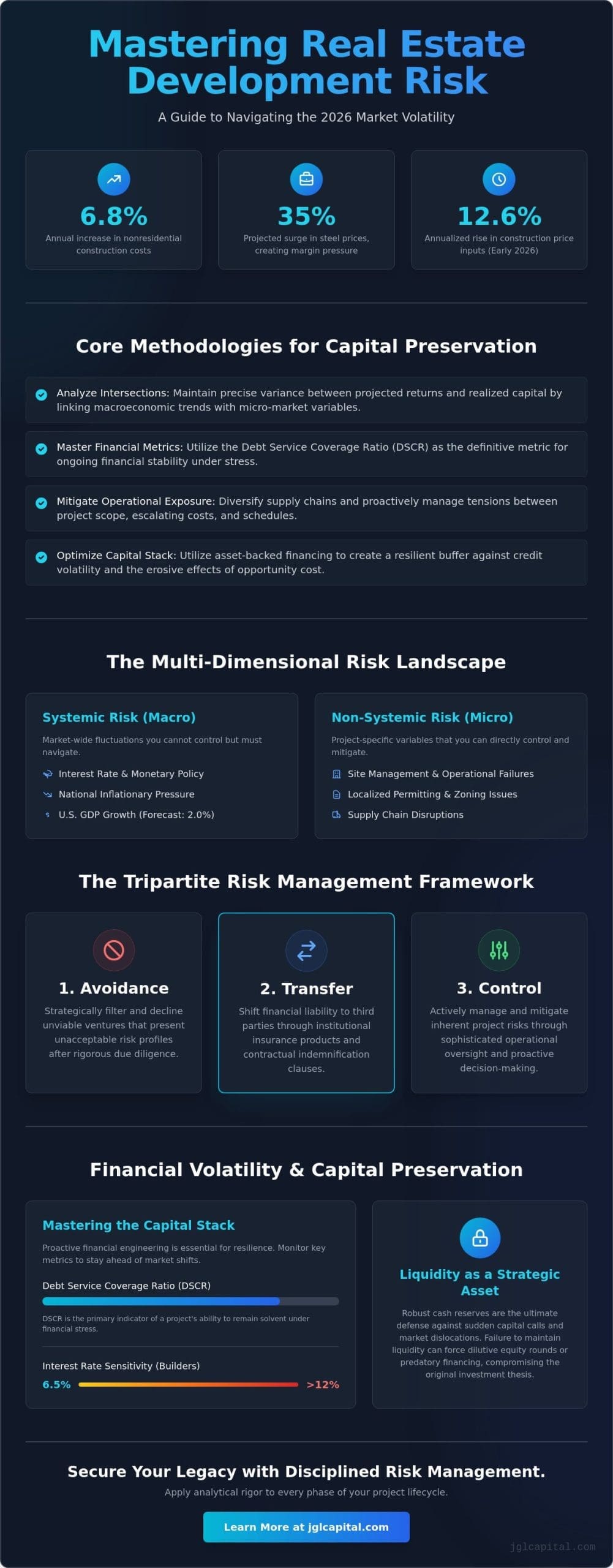
The traditional reliance on static contingency buffers is a relic of a low-volatility era that no longer exists for the sophisticated developer. In an environment where nonresidential construction costs have escalated by 6.8 percent annually and steel prices are projected to surge by as much as 35 percent, the margin for error has become increasingly unforgiving. You recognize that the preservation of equity is not achieved through the avoidance of volatility, but through the disciplined application of analytical rigor to every facet of the project lifecycle. This article serves as a definitive guide to mastering risk management for real estate developers, offering the sophisticated methodologies necessary to identify, quantify, and neutralize the multi-dimensional threats inherent in the 2026 market. We will examine the implementation of resilient capital stacks that withstand interest rate fluctuations, the navigation of new transit-oriented zoning reforms, and the strategic mitigation of supply chain disruptions to ensure your project timelines remain predictable and your long-term legacies are secured.
Key Takeaways
- Analyze the intersection of macroeconomic trends and micro-market variables to maintain a precise variance between projected returns and realized capital preservation.
- Master the application of sophisticated risk management for real estate developers by utilizing the Debt Service Coverage Ratio as a definitive metric for financial stability.
- Mitigate operational exposure by diversifying supply chains and managing the inherent tensions between project scope, escalating costs, and rigorous schedules.
- Utilize the Tripartite Framework to strategically avoid unviable ventures or transfer liabilities through institutional insurance and contractual indemnification.
- Optimize the capital stack with asset-backed financing to create a resilient buffer against credit volatility and the erosive effects of opportunity cost.
The Multi-Dimensional Landscape of Development Risk
Risk isn’t merely an abstract threat to profitability. It’s the measurable variance between your meticulously projected returns and the actual preservation of capital at the close of a project. In the current 2026 environment, where U.S. GDP growth is forecasted to slow to 2.0 percent, the margin for operational inefficiency has vanished. Effective risk management for real estate developers requires a transition from reactive crisis handling to a proactive posture of institutional stewardship. This discipline ensures that every decision, from land acquisition to final disposition, aligns with the overarching goal of protecting stakeholder equity through analytical rigor.
Many firms fall into the trap of a siloed approach. They treat financial volatility, regulatory hurdles, and construction delays as isolated incidents rather than interconnected variables. This fragmented perspective often leads to project failure because it ignores how a delay in New York’s SEQRA reforms can amplify interest rate exposure on a variable-rate bridge loan. A holistic framework recognizes that risk is a fluid, multi-dimensional landscape. By adopting The Tripartite Framework: Avoidance, Transfer, and Control, developers can engineer resilience into the very foundation of their capital stacks, ensuring that unexpected shifts don’t compromise the project’s core viability.
Systemic vs. Non-Systemic Risk in Real Estate
Systemic risks are the market-wide fluctuations that you can’t control but must navigate. Consider the current 30-year fixed mortgage rate of 6.33 percent or the national inflationary pressure on building materials. These macro factors dictate the baseline viability of a development. Non-systemic risks, however, are project-specific. They include operational failures, such as poor site management or localized permitting issues. While you can’t alter national monetary policy, you can exert control over your project’s internal variables through rigorous due diligence and sophisticated risk management for real estate developers.
The Velocity of Risk: Why Timing is a Critical Metric
Time is the greatest amplifier of exposure. The longer a project remains in the entitlement or construction phase, the more it’s subjected to external volatility. This is the “Time-Value of Risk.” In 2026, where construction price inputs rose at an annualized rate of 12.6 percent in the first two months alone, every week of delay translates to direct capital erosion. Compressing timelines isn’t just about efficiency; it’s a strategic defensive maneuver. By streamlining the permitting process and utilizing HUD environmental review exemptions for projects over 200 units, developers can reduce the window of vulnerability and lock in returns before the market shifts.
Financial Volatility and the Mechanics of Capital Preservation
Financial stability in large-scale property development isn’t a passive state. It’s the result of deliberate engineering within the capital stack. As interest rates for professional builders currently fluctuate between 6.5 percent and over 12 percent, the sensitivity of variable-rate debt becomes a primary concern for sophisticated practitioners. A central tenet of risk management for real estate developers involves the constant monitoring of the Debt Service Coverage Ratio (DSCR). This metric serves as a vital indicator of a project’s ability to remain solvent under stress. When debt service costs rise due to benchmark rate shifts, the margin for error in cash flow projections narrows. Maintaining equity requires a disciplined approach to leverage that prioritizes long-term resilience over immediate internal rate of return (IRR) maximization.
Liquidity reserves act as the ultimate defense against the unforeseen. In an environment where construction price inputs rose at an annualized rate of 12.6 percent in early 2026, the potential for sudden capital calls is a statistical reality rather than a remote possibility. Developers who fail to maintain robust cash positions often find themselves forced into dilutive equity rounds or predatory financing arrangements. By treating liquidity as a strategic asset, you ensure that your project can weather temporary market dislocations without compromising the integrity of the original investment thesis.
Leverage Ratios and Equity Protection
Determining the optimal Loan-to-Cost (LTC) ratio is a nuanced exercise in institutional stewardship. While high leverage might amplify potential returns, it also creates dangerous liquidity traps during market corrections. The record-high office CMBS delinquency rate of 12.34 percent recorded in January 2026 stands as a stark reminder of the risks associated with aggressive debt structures. By utilizing mezzanine financing or private equity to diversify the capital stack, developers can reduce their reliance on senior debt. This strategy preserves the developer’s ability to meet unforeseen obligations without triggering a default. Sophisticated partners often look for Strategic Financing as a Risk Management Tool to ensure that their equity remains protected even if market conditions deteriorate.
Interest Rate Hedging and Debt Structuring
In a climate where the 5/1 Adjustable-Rate Mortgage sits at 6.49 percent, hedging strategies like interest rate caps and swaps are no longer optional. They’re essential components of a defensive financial posture. Structuring debt draws to align precisely with verified construction milestones prevents the unnecessary accumulation of interest on unutilized capital. During transitional phases, such as the period between construction completion and permanent financing, utilizing fixed-rate bridge loans provides a necessary ceiling on borrowing costs. This predictability is crucial for maintaining project viability when market volatility threatens to erode margins. Developers who prioritize these structured solutions often find that aligning with a disciplined capital partner is the most effective way to navigate the complexities of the 2026 lending environment.
Operational Resilience: Managing Construction and Environmental Variables
The execution phase of any large-scale property development represents the period of maximum operational exposure. Achieving resilience during this stage requires a meticulous balancing of the “Triple Constraint”: scope, cost, and schedule. For practitioners of risk management for real estate developers, this balance is increasingly difficult to maintain as supply chain volatility persists. Projected increases in material costs for 2026 are significant, with steel expected to rise by 15-35 percent and copper by 25-50 percent. Such fluctuations necessitate a move away from single-source procurement toward a diversified supply chain strategy that anticipates geopolitical and trade-related disruptions. Relying on a single vendor in this climate is no longer a viable strategy for those committed to capital preservation.
Environmental due diligence must extend beyond mere compliance. Rigorous Phase I and Phase II assessments are essential for identifying latent liabilities that could derail a project’s financial feasibility long after the ground is broken. While recent regulatory shifts, such as the HUD environmental review streamlining effective June 22, 2026, offer a path to accelerated timelines for projects exceeding 200 units, they don’t absolve the developer of the responsibility to conduct thorough site investigations. Managing the performance risk of general contractors is equally vital. Utilizing performance bonds and liquidated damages clauses ensures that the project’s financial interests remain protected against contractor insolvency or substandard execution, effectively shifting the burden of performance back to the service provider.
Contingency Planning for Material and Labor Shortages
Establishing a 10-15 percent hard-cost contingency has become an institutional standard for projects initiated in 2026. This buffer is critical given that nonresidential construction costs rose 6.8 percent year-over-year in the first quarter. To further reduce site-specific labor risks, many developers are shifting toward modular and prefabricated components. These methods offer greater control over quality and timelines, effectively transferring a portion of the operational risk from the field to a controlled factory environment where labor shortages are less impactful on the critical path.
Environmental and Regulatory Entitlement Risk
Navigating the entitlement landscape requires more than legal expertise; it demands a proactive strategy of community and regulatory engagement. New laws, such as California’s Transit-Oriented Housing Law limiting local zoning restrictions near transit hubs, provide significant opportunities for higher-density development. However, these opportunities come with added layers of complexity that require sophisticated risk management for real estate developers. Developers must assess long-term climate resilience during site selection to ensure that assets remain viable and insurable over their entire lifecycle, particularly as sustainability and greenhouse gas reporting requirements intensify across major markets.
The Tripartite Framework: Avoidance, Transfer, and Control
The Tripartite Framework represents the pinnacle of institutional discipline, categorizing every potential threat into three actionable responses: avoidance, transfer, or control. Within the discipline of risk management for real estate developers, the most critical, yet often overlooked, component is risk avoidance. This is the “No-Go” decision. In a bifurcated market where the office sector faces significant stress, characterized by the record 12.34 percent CMBS delinquency rate in early 2026, the decision to decline a project that doesn’t meet rigorous solvency criteria is the highest form of stewardship. It requires a rejection of speculative trends in favor of timeless principles of capital preservation. Stewardship is defined by the courage to walk away from deals where the variance between projected returns and realized capital is too great.
Risk control involves the implementation of internal protocols designed to minimize the probability and impact of variables that cannot be avoided. This process begins during land acquisition and continues through the final exit. It encompasses everything from the DSCR monitoring mentioned previously to the rigorous oversight of construction milestones. By maintaining control over the internal environment, developers can neutralize non-systemic risks before they escalate into capital-eroding events. This proactive posture ensures that the developer remains a disciplined steward of capital rather than a passive observer of market forces.
The Strategic Use of Insurance Products
Institutional-grade insurance goes beyond basic general liability. Builders Risk and Professional Indemnity are essential for protecting against physical loss and design-related errors. For brownfield developments, Environmental Liability insurance is a non-negotiable requirement to mitigate latent site risks. Sophisticated developers often conduct a cost-benefit analysis of high-deductible plans. These plans allow institutional portfolios to retain manageable risks while ensuring catastrophic protection remains in place, provided the firm maintains sufficient liquidity reserves to cover the retention amounts.
Contractual Protections and Indemnification
Contractual indemnification serves as the primary mechanism for risk transfer. Drafting “Force Majeure” clauses for a post-2024 global economy requires precise language that accounts for modern supply chain volatility and geopolitical shifts. Liquidated damages are equally vital; they maintain schedule discipline by imposing financial consequences for delays. This is crucial when construction price inputs are rising at an annualized rate of 12.6 percent. Ensuring back-to-back contract alignment between developers, contractors, and lenders prevents gaps in liability. To fortify your project’s foundation, consider our institutional-grade construction financing solutions, which are designed to align with these rigorous risk-transfer protocols.
Strategic Financing as a Risk Management Tool
The selection of a financing partner represents a critical decision in the execution of a comprehensive capital preservation strategy. While traditional institutional lenders often impose rigid, credit-based constraints that can lead to funding freezes during market shifts, asset-backed lending offers a more resilient alternative. By focusing on the intrinsic value of the property and the project’s underlying feasibility, this approach provides a necessary buffer against personal credit volatility. For practitioners of risk management for real estate developers, the objective is to secure capital that is as adaptable as the project itself. Utilizing highly customized new construction loans allows developers to bypass the standardized requirements of conventional banks, ensuring that the capital stack remains functional even during periods of broader market contraction.
Collaborative underwriting serves as a primary asset in this framework. When a lender brings decades of institutional expertise to the table, their involvement functions as a secondary layer of due diligence. This relationship isn’t merely transactional; it’s a strategic alliance where the lender’s analytical rigor helps identify potential project-specific risks before they manifest as capital-eroding events. Having a partner who understands the mechanics of resource management is invaluable when navigating the complexities of the 2026 environment. This alignment of interests ensures that every draw and every milestone is scrutinized through the lens of long-term worth, distinguishing the partnership from more transactional lending models.
Asset-Based vs. Credit-Based Underwriting
Focusing on property value rather than individual credit scores provides developers with the flexibility required to navigate project pivots. Traditional banking structures often struggle to accommodate the nuances of high-stakes property development, particularly when regulatory shifts or supply chain disruptions necessitate a change in strategy. Asset-based underwriting reduces the risk of funding freezes by anchoring the loan to the collateral’s worth. This creates a more stable environment for project execution, as the lender remains committed to the asset’s success regardless of temporary fluctuations in the developer’s personal financial profile.
The Competitive Advantage of Private Money Speed
The velocity of capital is a critical metric in mitigating opportunity cost risk. In a competitive 2026 market where land acquisition opportunities are often fleeting, the ability to execute within days is a distinct competitive advantage. Utilizing commercial real estate loans to bridge the gap between development phases or to secure prime sites near major transit corridors ensures that your market position isn’t compromised by administrative delays. JGL Capital LLC positions itself as the strategic ally in these high-stakes project executions, offering the speed and precision required to build lasting legacies. By prioritizing disciplined action and intellectual capital, JGL Capital LLC ensures that your equity remains protected through every phase of the development lifecycle.
Institutional Stewardship in an Evolving Market
The transition from speculative growth to disciplined capital preservation requires a fundamental shift in operational philosophy. By internalizing the principles of the Tripartite Framework and prioritizing the Debt Service Coverage Ratio as a primary metric for stability, you ensure that your projects remain resilient against the systemic volatility of the 2026 landscape. This rigorous approach to risk management for real estate developers transforms uncertainty into a series of manageable variables, allowing for the creation of lasting legacies even in a bifurcated market. Success in this era is defined by the alignment of strategic objectives with a partner who values analytical rigor over marketing hyperbole.
Securing the right capital partner is the final, critical component of this defensive architecture. JGL Capital LLC provides the analytical rigor and institutional stability required for high-stakes project execution. With over 30 years of industry expertise, we specialize in asset-backed lending that prioritizes property value over personal credit volatility. Our specialized programs for new construction and bridge financing are designed to offer the flexibility and speed necessary for sophisticated developers to maintain their market position. We invite you to Partner with JGL Capital LLC for Disciplined Development Financing and align your objectives with a steward committed to the generation of long-term worth. Your vision deserves the security of a seasoned strategic ally.
Frequently Asked Questions
What are the primary financial risks in real estate development today?
The primary financial risks currently include interest rate volatility and the erosion of equity through escalating construction inputs. With construction loan rates for professional builders ranging from 6.5 percent to over 12 percent, the cost of debt service has become a critical variable in project solvency. Developers must also contend with a 6.8 percent year-over-year increase in nonresidential construction costs, which necessitates a more disciplined approach to capital allocation.
How does leverage impact a developer’s overall risk profile?
Leverage functions as a double-edged sword that amplifies potential internal rates of return while simultaneously increasing the probability of a liquidity trap. High Loan-to-Cost ratios reduce the margin for error, making a project more susceptible to default if market conditions shift or if debt service costs rise unexpectedly. The record 12.34 percent delinquency rate in office CMBS during early 2026 illustrates the danger of aggressive debt structures in a stressed market.
What is the difference between risk transfer and risk avoidance?
Risk avoidance involves the strategic decision to decline a project or path that doesn’t meet rigorous solvency criteria, whereas risk transfer utilizes mechanisms like insurance or contractual indemnification to shift liability to a third party. Avoidance is the highest form of stewardship, often manifesting as a “No-Go” decision during due diligence. Transfer, conversely, allows a developer to proceed with a project while neutralizing specific threats through institutional-grade insurance products.
How can developers mitigate construction delays caused by supply chain issues?
Developers can mitigate supply chain delays by diversifying their procurement sources and utilizing modular or prefabricated building components. This strategy is particularly vital in 2026, as steel prices are projected to rise by up to 35 percent and copper by up to 50 percent, necessitating a move away from high-risk, single-source vendor relationships. By shifting certain processes to a controlled factory environment, firms can also reduce their exposure to site-specific labor shortages.
Why is an environmental assessment considered a risk management tool?
An environmental assessment serves as a critical tool for identifying latent liabilities, such as soil contamination or protected habitats, before they derail a project’s financial feasibility. Rigorous Phase I and Phase II assessments provide the analytical rigor required to quantify these risks early in the acquisition phase. Even with HUD environmental review streamlining for projects over 200 units, these assessments remain essential for ensuring long-term asset insurability and regulatory compliance.
How does private money financing reduce execution risk for developers?
Private money financing reduces execution risk by prioritizing the speed of capital and asset-based underwriting over rigid personal credit requirements. This approach is a fundamental component of risk management for real estate developers, as it allows for the rapid acquisition of land or the seamless transition between development phases without the administrative delays common in traditional banking. By focusing on the intrinsic value of the property, these loans provide a more resilient funding source during project pivots.
What role does a contingency reserve play in project solvency?
A contingency reserve, typically established at an institutional standard of 10 to 15 percent of hard costs, serves as a vital buffer against unforeseen price increases. This reserve ensures project solvency when construction price inputs rise unexpectedly, as they did at an annualized rate of 12.6 percent in early 2026. Without this disciplined allocation of capital, even a minor delay or material price spike can lead to dilutive equity calls or project stagnation.
Can insurance cover all risks associated with a development project?
Insurance cannot cover all risks, as market-demand shifts and certain operational inefficiencies are generally considered uninsurable business risks. While products like Builders Risk and Professional Indemnity provide essential protection against physical loss and design errors, the developer remains responsible for the core investment thesis. Effective risk management for real estate developers requires a combination of robust insurance coverage and rigorous internal protocols to manage the variables that fall outside of traditional policy protections.