

The most significant threat to a project’s terminal value isn’t the headline interest rate, but the failure to account for the total cost of capital within the initial pro forma. While a nominal rate of 10% might appear competitive in the 2026 market, it’s often an insufficient indicator of the actual financial burden. Sophisticated investors understand that the hidden costs of hard money loans, ranging from complex origination structures to administrative fees, can quietly erode the anticipated internal rate of return. You’ve likely experienced the frustration of seeing projected margins tighten as closing disclosures reveal expenses that weren’t clearly articulated during the preliminary negotiations.
This article offers a comprehensive institutional evaluation designed to eliminate such ambiguity through rigorous capital cost modeling. We’ll provide the clarity you need to compare disparate lending offers and maintain the integrity of your investment strategy. By examining the precise mechanics of effective cost versus nominal rates, we’ll establish a framework for transparency that preserves your project’s profitability and ensures a disciplined approach to private capital.
Key Takeaways
- Establish a clear distinction between nominal interest rates and the effective cost of capital to ensure precise project valuation and disciplined resource allocation.
- Analyze the fiscal impact of transactional and operational fees, including origination points and performance-based draw expenses, on the project’s terminal value.
- Integrate a rigorous framework for modeling the hidden costs of hard money loans to prevent the unexpected erosion of profit margins during the closing process.
- Assess the sensitivity of your project’s Internal Rate of Return (IRR) to front-loaded capital costs and administrative underwriting requirements through quantitative modeling.
- Prioritize strategic alliances with transparent capital partners who offer customized financing solutions designed to align with sophisticated investment objectives and long-term value preservation.
Defining the Total Cost of Capital in Private Lending
Institutional capital allocation requires a fundamental shift in perspective from simple interest rate comparison to a rigorous evaluation of the total cost of borrowing. For the sophisticated investor, the acquisition of high-stakes assets often necessitates a speed of execution that traditional banking institutions simply cannot match. In these environments, private capital serves as a vital strategic lever for value creation. However, a disciplined pro forma must account for more than just the monthly debt service. The institutional definition of the hidden costs of hard money loans refers to the aggregate of overlooked variables that significantly alter the project’s financial trajectory, including:
- Front-loaded origination points and underwriting fees
- Administrative processing and documentation costs
- Capital release fees for construction-heavy projects
- Extension premiums and early exit penalties
Sophisticated partners prioritize the certainty of execution and capital availability over the pursuit of the lowest possible nominal rate. This prioritization reflects a commitment to seizing market opportunities where the speed of funding is the primary determinant of success.
The Asset-Based Lending Paradigm
The transition toward an asset-based model fundamentally reconfigures the risk profile of a transaction. By prioritizing the physical asset’s intrinsic value and its projected performance over the borrower’s personal credit history, lenders provide an expedited path to liquidity. This streamlined underwriting process, while highly efficient, carries inherent costs that reflect the lender’s rapid deployment of capital and intensive due diligence. Asset-based lending is a specialized strategic tool used to secure immediate liquidity by leveraging tangible property value rather than traditional credit metrics. For a foundational Hard money loan overview, one can see how these structures provide the flexibility required for time-sensitive commercial acquisitions. This paradigm shift allows for the acquisition of distressed or non-stabilized assets that traditional lenders typically reject.
Nominal vs. Effective Interest Rates
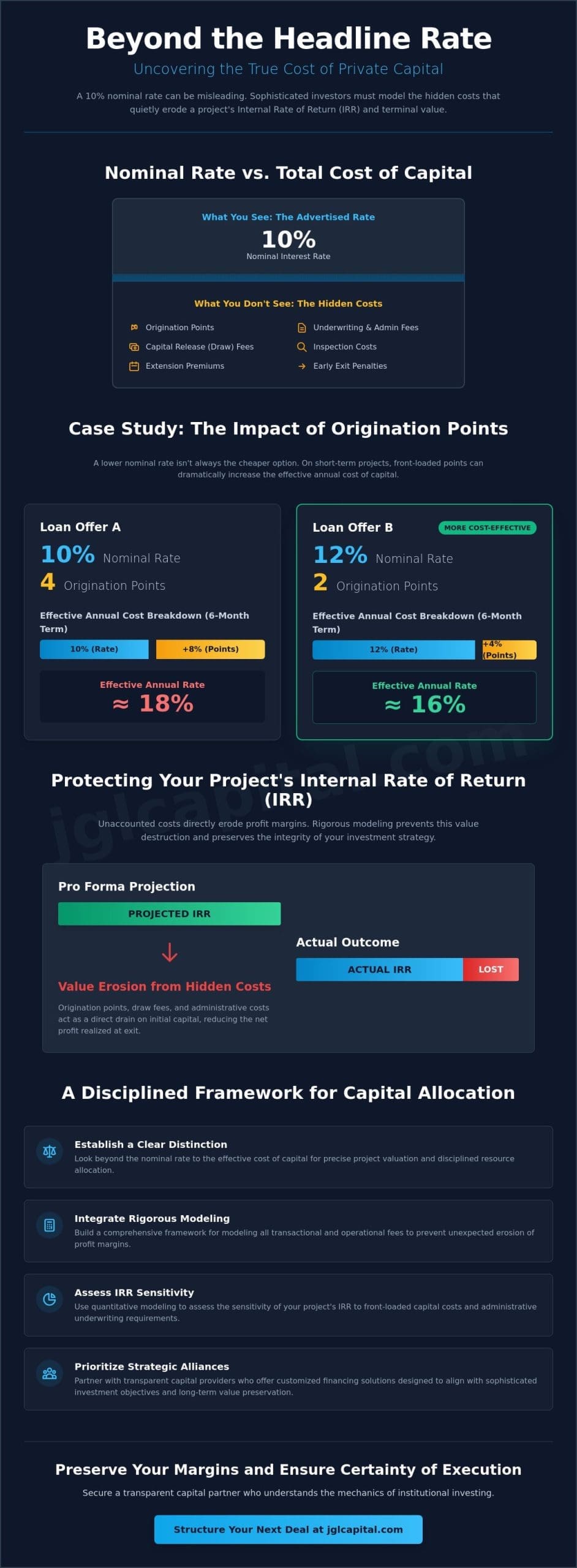
Distinguishing between the nominal rate and the effective cost of borrowing is essential for preserving project margins. The nominal rate is merely the surface-level percentage stated on the term sheet. In contrast, the effective rate accounts for the erosion of capital caused by front-loaded fees and origination points. The duration of the holding period plays a decisive role in this calculation. If a project has a short lifecycle, the impact of origination points is magnified across the annualized cost. For instance, a loan with a 12% nominal rate and 2 origination points may prove more cost-effective than a 10% rate carrying 4 points, especially when the capital is deployed for less than twelve months. Failing to model these hidden costs of hard money loans results in a skewed perception of the project’s true Internal Rate of Return (IRR). Precision in this area isn’t optional; it’s a requirement for high-level asset management.
Primary Transactional Costs: Origination and Underwriting Fees
Primary transactional costs represent the immediate capital outlay required to activate a private lending facility. These expenditures aren’t merely administrative burdens; they’re strategic components of a risk-mitigation framework that ensures the stability of the lending ecosystem. While interest rates capture the most attention, the hidden costs of hard money loans often manifest most prominently during the initial transactional phase through origination points and underwriting fees. For investors seeking to preserve margins, understanding the institutional rationale behind these costs is essential for accurate pro forma modeling. This clarity allows for a more disciplined approach to structuring customized capital solutions that align with specific project timelines.
In the 2026 fiscal environment, transactional integrity remains paramount. Processing and documentation costs serve to protect the legal standing of the strategic alliance between borrower and lender. Furthermore, 2026 has seen a heightened reliance on sophisticated appraisal methodologies and Broker Price Opinions (BPOs) to validate After Repair Value (ARV), which remains the primary metric for asset-based lending. These requirements ensure that the capital deployment is grounded in analytical rigor rather than speculative trends.
The Rationale for Origination Points
Origination points function as a risk-adjusted premium, compensating the lender for the rapid sourcing and deployment of non-bank capital. In California, for example, the average origination fee in Q1 2026 stood at 2.3%, reflecting the cost of maintaining high-liquidity reserves. Investors can often negotiate these points by demonstrating a lower Loan-to-Value (LTV) ratio or a proven history of successful project exits. There’s a direct correlation between the magnitude of these points and the speed of funding. You’re effectively paying for the ability to bypass the 30 to 45 day delays typical of traditional banking institutions. Understanding common hard money loan fees helps investors distinguish between standard market premiums and unnecessary expenses.
Underwriting and Due Diligence Rigor
Underwriting fees represent the price of professional property validation and rigorous due diligence. Unlike retail mortgages, institutional private lending often utilizes flat fees rather than percentage-based administrative costs to maintain transparency. In exchange for these fees, the investor receives a comprehensive internal review that confirms the viability of the asset and the proposed exit strategy. This process mitigates the risk of unforeseen complications during the project lifecycle. Transparency in document preparation and internal review expenses is a hallmark of a seasoned partner. It ensures that the hidden costs of hard money loans don’t unexpectedly erode the project’s terminal value at the closing table. A disciplined steward of capital provides a clear breakdown of these costs long before the final disclosures are signed.
Operational and Performance-Based Costs: Draws, Inspections, and Extensions
While the initial transactional phase establishes the primary cost of capital, the operational lifecycle of a project introduces a secondary layer of fiscal variables. These performance-based expenses, frequently categorized among the hidden costs of hard money loans, are often underestimated during the initial underwriting stage. For sophisticated investors, managing the phased release of capital and the associated administrative requirements is a critical component of project oversight. A disciplined approach to loan servicing ensures that capital flow remains consistent with project milestones, preventing liquidity bottlenecks that could jeopardize the terminal value of the asset.
Operational costs typically center on the following mechanics:
- Draw fees associated with phased capital disbursement
- Third-party inspection fees for milestone validation
- Administrative servicing costs for ongoing reporting
- Extension premiums for projects exceeding the initial term
Adherence to established Lending regulations ensures that these operational procedures remain transparent and legally robust, providing a stable framework for both the capital steward and the developer. This transparency is vital for maintaining the integrity of the strategic alliance throughout the project’s duration.
Managing Construction Draw Logistics
For New Construction Loans and extensive renovations, the draw schedule serves as the primary mechanism for capital deployment. Each draw request typically initiates a third-party inspection to verify that the work has been completed according to the approved budget and timeline. While these inspections incur costs, they function as a form of value preservation by providing professional validation of project progress. Structuring the draw schedule to minimize administrative overhead is essential. Excessive draw requests can lead to a cumulative increase in inspection fees, whereas too few can strain the developer’s working capital. A balanced approach optimizes the cost-to-liquidity ratio.
The Financial Gravity of Extension Fees
Project delays represent one of the most significant threats to the projected internal rate of return. When a 12-month term extends into 18 months, the effective cost of capital shifts dramatically. Extension fees are not merely administrative penalties; they represent the opportunity cost of capital that remains deployed beyond the anticipated exit. Institutional private money contracts typically structure these clauses with a combination of a flat extension fee and a potential adjustment to the interest rate. Sophisticated developers mitigate this risk by building a “time buffer” into their initial loan request. Recognizing these hidden costs of hard money loans early allows for a more realistic assessment of the project’s sensitivity to timeline fluctuations. Precision in time-modeling is just as important as precision in budget-modeling.
Quantitative Modeling: Assessing the Impact on Project IRR
Integrating the aggregate financial burden of private capital into a project’s pro forma requires a shift from qualitative expectations to quantitative precision. When modeling the hidden costs of hard money loans, one must recognize that front-loaded origination points exert a disproportionate influence on the Internal Rate of Return (IRR). Points paid at day zero are the most expensive dollars. Unlike interest payments, which are distributed across the project’s lifecycle, points are deducted from the initial disbursement, effectively reducing the net capital available for asset acquisition or development. This initial erosion of capital means the investor is paying interest on the gross loan amount while only utilizing the net proceeds, a reality that must be reflected in any sophisticated sensitivity analysis.
Calculating the Total Cost of Borrowing
A formulaic approach to determining total cash-out-of-pocket at closing must account for origination fees, legal documentation, and any escrowed interest reserves. The inclusion of an “Exit Fee” in the modeling process allows for a more accurate projection of the net proceeds available upon project completion. These back-end costs, while sometimes overlooked in preliminary discussions, are essential variables in determining the terminal value of the investment. Prepayment penalties serve as a critical mechanism to ensure the lender achieves a minimum risk-adjusted yield regardless of an accelerated exit. By accounting for these hidden costs of hard money loans at the outset, developers can avoid the unexpected margin compression that often occurs during the final stages of a project.
Hard Money vs. Equity Capital
Sophisticated investors often find that high-interest debt is significantly more efficient than the dilution of ownership that accompanies equity partnerships. While a bridge loan may appear expensive on a nominal basis, the total cost of capital is frequently lower than giving away 30% to 50% of the project’s upside to an equity partner. The “Opportunity Cost” of traditional bank delays can be catastrophic in competitive markets, where the ability to close in three to five days is often the deciding factor in securing a high-yield asset. By engaging with hard money lenders florida, developers can maximize their leverage and preserve owner equity, ensuring that the lion’s share of the project’s growth remains with the principal. This strategic allocation of capital allows for the preservation of project margins while maintaining the agility required for rapid asset acquisition.
To ensure your next project is modeled with institutional precision, contact our team for a comprehensive capital evaluation.
Collaborative Capital Allocation with JGL Capital
Strategic asset acquisition requires more than just a source of funds; it demands a partnership grounded in transparency and analytical rigor. At JGL Capital, we view the provision of capital as a form of high-level strategic alliance rather than a simple service provision. By leveraging 30 years of industry expertise, we’ve developed a methodology that prioritizes the alignment of objectives between capital stewards and developers. This approach ensures that the hidden costs of hard money loans are identified and integrated into the financial model long before the closing date. Our commitment to stability and disciplined management provides sophisticated investors with the security they need to execute complex transactions with confidence.
The role of a disciplined steward is to facilitate the creation of long-term value by removing the ambiguity that often plagues private lending. We streamline the path to closing for sophisticated developers by offering a steady, measured communication rhythm that mirrors our patient approach to long-term objectives. This methodical presentation of principles ensures that every partner understands the total cost of capital, allowing for the preservation of project margins and the generation of significant worth across the asset’s lifecycle.
A Disciplined Approach to Private Money
The JGL Capital philosophy is rooted in the rejection of speculative trends in favor of timeless financial principles. We provide absolute clarity in fee structures, ensuring that your pro forma remains accurate and free from the erosion of unexpected administrative costs. For developers managing high-stakes projects, the ability to customize new construction loans is essential for maintaining liquidity across phased milestones. We work closely with our partners to ensure that every capital solution is individually tailored to the project’s specific risk profile and exit strategy. This meticulous attention to detail distinguishes a seasoned partner from more transactional competitors who may overlook the nuances of a sophisticated capital stack.
Securing Your Next Strategic Acquisition
Engaging with a seasoned private money broker allows you to streamline the path to closing while preserving project margins. We understand that in a competitive market, the speed of execution is often the most valuable asset. Our internal processes are designed to provide rapid property validation and funding without sacrificing the due diligence required for long-term value preservation. Initiating a consultation for asset-backed financing is the first step toward a more disciplined and transparent approach to capital allocation. We invite you to Consult with JGL Capital for a transparent capital analysis to ensure that your next acquisition is supported by the intellectual capital and stability your project deserves. By addressing the hidden costs of hard money loans proactively, we help you build a lasting legacy through careful, deliberate action.
Achieving Long-Term Value Preservation through Disciplined Capital Analysis
The preservation of project margins in the 2026 real estate landscape requires a transition from superficial rate comparisons to a rigorous evaluation of the total cost of capital. By meticulously modeling the hidden costs of hard money loans, including front-loaded points and performance-based draw fees, sophisticated investors ensure that their terminal value remains protected against unexpected erosion. This disciplined approach distinguishes the strategic partner from the transactional lender. It’s the difference between a project that merely survives and one that generates lasting wealth through precise financial stewardship.
JGL Capital brings over 30 years of industry expertise to every strategic alliance, offering a specialized focus on asset-backed new construction and commercial bridge loans. With a national reach and a commitment to transparency, we provide the stability required for high-stakes asset management. We invite you to Secure Institutional-Grade Capital with Transparent Terms from JGL Capital today. Your commitment to analytical rigor deserves a partner that values integrity and long-term growth above all else. We look forward to supporting your next strategic acquisition with the precision it requires.
Frequently Asked Questions
Are hard money loan fees higher than conventional mortgage fees?
Hard money transactional costs are notably higher than conventional mortgage fees because they reflect the expedited nature of capital deployment and the lender’s focus on asset value rather than traditional credit metrics. This premium compensates the capital steward for the rapid liquidity provided in time-sensitive acquisitions. While conventional loans prioritize borrower history, private capital focuses on the viability of the project, necessitating a higher cost of capital to offset the increased risk and speed of execution.
What are origination points and why are they charged in private lending?
Origination points represent a percentage-based fee charged at the inception of the loan to cover the costs of capital sourcing, risk assessment, and administrative deployment. These points allow institutional lenders to achieve a risk-adjusted return while providing the agility required for complex commercial transactions. They’re a fundamental component of the total cost of capital, ensuring that the lender can maintain the liquidity reserves necessary for rapid, asset-based funding across a national reach.
Can I roll hard money closing costs and fees into the loan amount?
Investors can frequently capitalize closing costs and fees into the total loan facility, provided the transaction remains within established Loan-to-Value and After Repair Value parameters. This mechanism is essential for sophisticated partners who prioritize the preservation of working capital for operational project needs. By incorporating these expenses into the principal, developers can manage their initial cash outlay effectively, though this approach will increase the total interest paid over the project’s lifecycle.
What happens if I need to extend the term of my hard money loan?
Term extensions typically require the payment of an extension fee and may involve an adjustment to the nominal interest rate to reflect prolonged capital exposure and the opportunity cost of the deployed funds. Identifying these potential expenses early is vital; they’re often considered among the hidden costs of hard money loans that can unexpectedly impact the final project pro forma. A disciplined approach to extension clauses ensures that both the lender and the borrower remain aligned during project delays.
Do hard money loans have prepayment penalties in 2026?
Prepayment penalties remain a standard feature in 2026 institutional private lending to protect the lender’s projected yield against an early exit. These clauses, which may include minimum interest requirements or flat penalties, ensure that the capital steward receives a baseline risk-adjusted return. This structure is a necessary component of maintaining a stable lending ecosystem, allowing for the continued availability of private capital for high-stakes acquisitions and development projects.
What is an exit fee in the context of commercial bridge loans?
An exit fee is a specific financial obligation due upon the maturity or payoff of a commercial bridge loan, often structured to manage the total cost of capital across the project’s duration. This fee allows for a more balanced distribution of costs between the initial closing and the project’s conclusion, supporting strategic agility for the borrower. It serves as a final component of the lender’s yield and must be integrated into the project’s terminal value calculations to ensure accurate margin modeling.
How do draw fees work for new construction projects?
Draw fees are administrative expenses associated with the phased disbursement of capital for new construction or renovation projects. These fees cover the logistical requirements of managing the loan’s construction escrow, ensuring that capital is released in alignment with verified project milestones. By charging for each draw request, lenders can maintain the rigorous oversight required to prevent capital mismanagement and ensure that the project remains on its projected financial trajectory toward a successful exit.
Why do lenders require third-party inspections for draw releases?
Third-party inspections provide an objective validation of project progress, serving as a critical risk-mitigation tool for both the lender and the investor. By verifying that construction milestones have been reached according to the approved budget, these inspections prevent the premature release of capital and ensure the project’s terminal value remains secure. This professional oversight is a form of value preservation, confirming that the physical asset’s development remains consistent with the initial underwriting and pro forma expectations.