

Why should a sophisticated investor’s liquidity and portfolio expansion be tethered to the static, historical data of a personal tax return? For many high-net-worth stakeholders, the traditional banking sector’s reliance on paper income creates an artificial barrier that ignores the intrinsic value and cash flow of the underlying asset. You likely understand the frustration of seeing a prime acquisition opportunity slip away because a lender’s underwriting department couldn’t reconcile your strategic tax planning with your actual capital strength. This guide demonstrates how the modern market for real estate financing without tax returns has matured into a robust, institutional-grade alternative that prioritizes asset-backed performance over personal IRS documentation.
By reading this analysis, you’ll discover how to leverage specialized capital, such as DSCR and bridge loans, to accelerate your portfolio growth while maintaining the agility required in the 2026 fiscal environment. We’ll examine the strategic alignment of asset-based underwriting and the operational efficiencies gained through expert lending partnerships. This exploration provides a comprehensive overview of how disciplined investors utilize sophisticated debt structures to ensure their capital deployment remains as dynamic as the markets they navigate.
Key Takeaways
- Understand the transition toward asset-based underwriting, where property-level performance and intrinsic value supersede traditional IRS-centric documentation.
- Identify the rigorous technical mechanisms used for alternative income verification to ensure your capital deployment remains both efficient and compliant.
- Evaluate the strategic distinctions between DSCR and bridge loan structures as primary vehicles for real estate financing without tax returns.
- Recognize the institutional underwriting standards required to maintain financial discipline while bypassing conventional personal income hurdles.
- Discover how a strategic alliance with a seasoned lender facilitates the acquisition of bespoke capital solutions for complex multi-family or commercial projects.
The Paradigm Shift in Modern Real Estate Capital Allocation
The traditional lending environment often operates on a paradox where the most successful investors appear the least qualified on paper. Within the current fiscal environment, the reliance on historical personal income data has become an antiquated metric that fails to align with the sophisticated strategies of high-net-worth stakeholders. Real estate financing without tax returns represents a fundamental transition toward asset-based underwriting; a disciplined methodology that prioritizes the economic viability of a property over the personal tax history of the borrower. This shift isn’t merely a convenience for those with complex income streams. It’s a strategic necessity for maintaining capital velocity in a market characterized by both volatility and rapid opportunity.
The Limitations of Conventional Mortgage Underwriting
Conventional underwriting frameworks are often unable to reconcile modern tax advantages with actual liquidity. Under the One Big Beautiful Bill Act of July 2025, the permanence of 100% bonus depreciation allows investors to deduct the full cost of qualifying assets in a single year. While this is a powerful tool for wealth preservation, it frequently results in a “paper loss” that triggers automatic rejections from traditional banks. These institutions focus on taxable income rather than the true cash flow generated by a robust portfolio. This discrepancy creates a significant gap between financial reality and institutional perception. Furthermore, the excessive documentation requirements of traditional lenders often lead to delays that prove fatal in competitive acquisition scenarios where speed is a primary component of deal certainty.
Defining Asset-Based Lending for the Sophisticated Investor
Asset-based lending represents an institutional grade of capital that evaluates risk through the lens of property performance and resource management. Unlike historical No-Documentation (No-Doc) Loans that were often associated with subprime consumer markets, modern real estate financing without tax returns is rooted in analytical rigor and the intrinsic value of the real estate. It’s a form of strategic stewardship where the lender and investor align their objectives based on the debt service capabilities of the asset itself. This approach allows for highly customized solutions that recognize the following:
- Revenue Potential: The focus remains on the property’s ability to generate worth and cover obligations.
- Strategic Agility: Capital is deployed based on the merits of the transaction rather than the administrative hurdles of personal income verification.
- Portfolio Acceleration: Investors can scale their holdings without being limited by debt-to-income ratios that ignore commercial reality.
By shifting the focus to property-level financial performance, sophisticated partners can unlock capital that traditional institutions simply cannot provide. This methodology ensures that capital remains a tool for growth rather than a bottleneck in the investment lifecycle.
Primary Mechanisms of Non-Traditional Income Verification
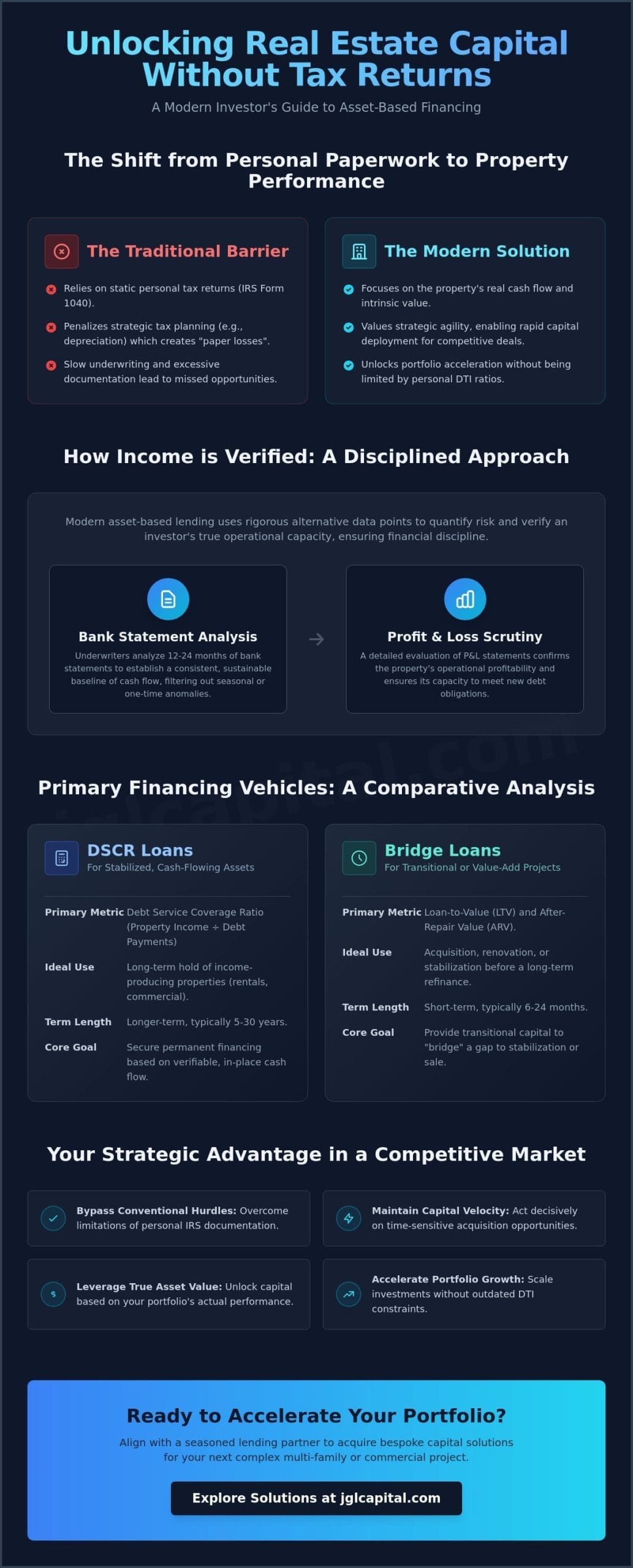
The shift toward asset-centric capital requires a sophisticated understanding of how liquidity and cash flow are verified in the absence of traditional IRS filings. While the term no-documentation mortgage may suggest a lack of oversight, the reality for professional investors is a process defined by technical rigor and analytical scrutiny. Lenders who facilitate real estate financing without tax returns utilize alternative data points to quantify risk, ensuring that the borrower’s operational capacity aligns with the proposed debt obligations. This verification process often centers on the consistency of cash flow rather than the bottom-line taxable income reported on a Form 1040, which is frequently distorted by strategic depreciation and interest write-offs.
Bank Statement and P&L Programs
One of the primary pillars of this framework involves the comprehensive analysis of 12 to 24 months of bank statements to establish a baseline of sustainable income. This duration allows underwriters to filter out seasonal fluctuations and identify the true capital strength of an entity. It’s essential to distinguish between personal and business cash flow during this assessment to ensure that the risk profile remains accurate. For self-employed developers and portfolio managers, the presentation of a professionally prepared Profit and Loss (P&L) statement serves as a critical instrument of credibility. These documents, when prepared by a certified financial professional, provide a clear narrative of operational efficiency that tax returns often obscure.
The 1099 and Asset-Qualifier Framework
Independent contractors and consultants often find that 1099-NEC forms provide a more accurate reflection of their gross revenue than their eventual net income after deductions. Underwriting models in 2026 have evolved to treat these forms as reliable precursors to liquidity, provided they’re supported by a history of consistent contract renewals and seasoned assets. Additionally, asset-qualifier structures allow high-net-worth stakeholders to utilize their liquid portfolios as the primary collateral, bypassing income verification entirely in favor of a high-liquidity coverage ratio. In markets requiring extreme speed, such as the Southeast, engaging with hard money lenders Florida can provide the rapid, asset-based verification necessary to secure a position in a high-demand multi-family or commercial development.
Establishing this level of fiscal transparency requires a disciplined approach to record-keeping and a focus on long-term growth. When you’re ready to explore how these mechanisms can support your next acquisition, aligning with a strategic lending partner ensures that your capital structure is both resilient and responsive to market shifts. By focusing on the intrinsic value of the asset and verified liquidity reserves, the underwriting process maintains institutional integrity while providing the flexibility that traditional banking lacks.
Comparative Analysis: DSCR vs. Private Money Structures
The selection of a capital structure depends on the property’s lifecycle and the investor’s long-term objectives. While retail products often focus on the mere absence of documentation, institutional real estate financing without tax returns focuses on the presence of measurable performance. This comparative analysis examines how different asset-backed structures serve specific strategic needs, moving from long-term wealth preservation to rapid capital recycling. The distinction lies in how risk is quantified; one model emphasizes current yield, while the other prioritizes future value and the speed of execution.
The DSCR Model for Passive Income Portfolios
The Debt Service Coverage Ratio (DSCR) remains the primary metric for evaluating income-producing assets within a disciplined portfolio. By dividing the property’s Net Operating Income (NOI) by its total debt service, lenders determine the asset’s ability to sustain its own obligations without relying on the borrower’s external liquidity. This model is particularly effective for multi-family acquisitions; the collective rent roll provides a more reliable indicator of risk than a single individual’s personal tax filing. When integrated with commercial real estate loans, the DSCR framework allows for the scaling of larger projects without the friction of personal income caps. It’s the preferred vehicle for rental portfolios because it aligns the loan’s success directly with the property’s revenue potential.
Bridge Loans and Fix-and-Flip Capital
Transitional capital serves a distinct tactical purpose where speed and asset value outweigh long-term amortization needs. Bridge financing prioritizes immediate agility, allowing investors to secure properties before permanent financing is viable. This is vital for stabilization projects where current cash flow may not yet meet institutional standards. For instance, fix and flip loans Florida allow investors to acquire and renovate assets in high-velocity markets. These structures utilize the after-repair value (ARV) to determine leverage, ensuring that capital is available for the physical improvements that generate worth. Similarly, new construction loans utilize future value rather than historical taxes, providing a path for developers to execute builds based on projected worth. While these structures may require slightly higher equity participation, often 20% to 25% for well-qualified borrowers in 2026, they offer a level of deal certainty that traditional banks cannot provide.
Strategic Underwriting: Navigating the Risk and Compliance Framework
A pervasive misconception exists within the broader market that real estate financing without tax returns implies a relaxation of underwriting standards or a descent into subprime territory. In reality, the absence of personal tax documentation necessitates a more rigorous, albeit different, form of institutional discipline. Capital providers in this space don’t ignore risk. Instead, they shift their analytical focus toward the tangible performance of the asset and the operational history of the principal. This transition from personal to property-level accountability requires a sophisticated alignment of interests; the transparency of the transaction and the liquidity of the sponsor become the primary determinants of the capital’s cost and structure.
Mitigating Risk in Asset-Backed Transactions
The appraisal serves as the analytical anchor in asset-backed transactions. Unlike residential valuations that may rely on simple comparable sales, institutional due diligence for multi-family or commercial assets involves a deep dive into market absorption rates, expense ratios, and replacement costs. Lenders also place significant weight on the borrower’s track record. A developer with a history of successful completions and stabilized exits demonstrates a level of competence that mitigates risk more effectively than any personal income statement could. This alignment of objectives ensures that both the lender and the investor are working toward the same outcome. It focuses on the generation of sustainable worth rather than the mere fulfillment of administrative checklists.
The Process of Capital Acquisition in 2026
Preparing an institutional-grade investment package in 2026 requires more than just a list of assets. It demands a clear narrative of the project’s lifecycle, supported by verified third-party data and a well-defined exit strategy. Private money lending is inherently transitional. The path to permanent refinancing or asset disposition must be articulated with precision to satisfy compliance frameworks. These underwriting decisions are heavily influenced by broader real estate investing philosophies that prioritize long-term stability over speculative growth. By presenting a comprehensive deal room that includes detailed project budgets, market feasibility studies, and proof of liquidity, investors can secure terms that reflect their strategic discipline.
Securing high-leverage capital without tax returns is a function of professional preparation and the ability to demonstrate asset-level viability. If your current portfolio requires a more agile capital structure that traditional banks cannot provide, you should consult with a strategic lending partner to evaluate your options. This approach ensures that your financing is an extension of your investment strategy rather than a hurdle to be cleared. Success in this framework is defined by the quality of the asset and the integrity of the partnership.
JGL Capital LLC: Facilitating Institutional-Grade Transitional Capital
JGL Capital LLC operates as a seasoned strategic partner for investors who require a more nuanced approach to capital than traditional banking institutions can provide. The firm has established a history of over 30 years as a disciplined steward of value; it facilitates real estate financing without tax returns by applying a lens of analytical rigor to every transaction. By prioritizing the preservation of wealth and the generation of worth over simple transactional volume, JGL Capital LLC distinguishes itself as an institutional ally. This commitment to excellence ensures that every debt structure is meticulously balanced to reflect the gravity of high-stakes management. The firm’s intellectual capital allows it to navigate a diverse capital landscape, identifying the most efficient pathways for resource allocation while maintaining a focus on long-term growth and integrity.
A Legacy of Analytical Rigor and Strategic Alliance
Working with industry veterans provides a significant advantage when evaluating the revenue potential of complex assets. JGL Capital LLC provides customized solutions for multi-family loans and residential projects; this ensures that the financing aligns with the property’s specific lifecycle stage. The firm’s national reach enables it to serve sophisticated developers across the United States, projecting a confidence that is grounded in historical performance rather than speculative trends. Whether the strategy requires bridge loans to stabilize an acquisition or rental property loans for a long-term hold, the solutions provided by JGL Capital LLC are bespoke and highly individual. This methodology recognizes that every project carries unique requirements, necessitating a collaborative relationship rather than a simple service provision.
Securing Your Next Strategic Capital Allocation
The process of moving from an investment vision to funded capital requires a streamlined alternative to the delays inherent in traditional mortgage underwriting. High-net-worth stakeholders can initiate a consultation by presenting a deal room that emphasizes the property’s cash flow and the sponsor’s liquidity. This approach closes the gap between opportunity and execution, providing the agility necessary to compete in high-demand markets. It is a strategic alignment that values the intrinsic worth of the real estate over the static data of an IRS filing. By choosing a partner like JGL Capital LLC, which is dedicated to disciplined stewardship, investors ensure that their capital deployment is both resilient and responsive to the evolving 2026 market. Success in this framework is defined by the quality of the asset and the strength of the alliance.
Advancing Your Portfolio Through Strategic Capital Alignment
The transition toward asset-centric underwriting represents more than a tactical adjustment; it’s a fundamental recognition that property-level performance is the most reliable indicator of financial merit. By prioritizing the intrinsic value of the asset and utilizing modern verification mechanisms, sophisticated investors can bypass the limitations of traditional banking. The principles outlined here demonstrate how real estate financing without tax returns provides the agility required to scale portfolios in a competitive market while maintaining institutional-grade discipline.
Precision remains the priority. JGL Capital LLC brings over 30 years of industry expertise to every partnership, offering a national scope that serves the needs of the most demanding investors. Our asset-backed focus ensures that your capital structure is aligned with the actual revenue potential of your real estate holdings. To ensure your next acquisition is supported by a resilient and highly customized debt structure, you’re invited to consult with JGL Capital LLC for a tailored capital solution. Achieving your long-term objectives requires a partner who values your vision as much as the assets themselves.
Frequently Asked Questions
Do no-income verification mortgages still exist for real estate investors in 2026?
Yes, these products remain a cornerstone of the private lending market, though they’re technically categorized as asset-based or “Non-QM” loans. In 2026, these structures are defined by a disciplined focus on the property’s revenue potential rather than the borrower’s personal tax history. They allow sophisticated stakeholders to deploy capital efficiently by utilizing debt service coverage ratios or verified liquid reserves as the primary qualifying metrics.
How does a DSCR loan differ from a traditional mortgage for self-employed individuals?
A DSCR loan evaluates the cash flow of the underlying property, whereas a traditional mortgage relies on the borrower’s personal debt-to-income ratio. For self-employed investors, this is a critical distinction because it ignores the “paper losses” created by strategic tax deductions like depreciation. This methodology ensures that the property’s Net Operating Income is the primary indicator of its ability to satisfy debt obligations.
What are the typical down payment requirements for loans without tax returns?
Institutional lenders generally require a down payment ranging from 20% to 25% for most asset-backed programs in the 2026 market. For “no-ratio” loans, which don’t factor in a specific income coverage, the minimum equity requirement is typically 20%. Well-qualified borrowers with FICO scores above 720 may access more favorable terms, but risk mitigation remains a priority for capital providers in this space.
Can I use bank statements to qualify for a commercial real estate bridge loan?
Bank statements serve as a primary mechanism for verifying liquidity and cash flow in bridge financing scenarios. Lenders typically analyze 12 to 24 months of activity to establish a baseline of operational strength and interest carry capacity. This approach provides a clear narrative of the sponsor’s capital position without the administrative hurdles and delays associated with traditional commercial bank underwriting.
Is it possible to secure new construction financing without traditional income proof?
New construction financing in the private sector is primarily underwritten based on the project’s after-repair value and the developer’s historical track record. While traditional income proof isn’t the focal point, lenders require a detailed project budget and proof of liquidity to ensure the build remains capitalized. This alignment of objectives prioritizes the physical milestones of the project over the principal’s personal tax filings.
What is the role of a private money broker in securing asset-backed financing?
A private money broker acts as a strategic intermediary who aligns a complex transaction with the most appropriate institutional capital source. They’re essential for navigating the landscape of real estate financing without tax returns, as they understand the specific underwriting nuances of different asset classes. This role ensures that the investment package is presented with the analytical rigor required to secure bespoke debt structures.
Are interest rates significantly higher for real estate loans that do not require tax returns?
Rates for DSCR and bank statement programs typically carry a premium of 0.75% to 2.0% over conventional investment property loans. In June 2026, well-qualified domestic borrowers often see rates between 6.12% and 6.75%, while hard money structures for transitional assets range from 9.5% to 18%. This pricing reflects the increased flexibility, speed, and asset-focused underwriting that these non-traditional programs provide.
How quickly can asset-backed loans be funded compared to traditional bank financing?
Asset-backed loans can often be funded within 7 to 14 days, providing a significant advantage over the 30 to 60 days required by traditional banks. This accelerated timeline is possible because the underwriting process is streamlined to focus on property-level data and verified liquidity. For investors in high-velocity markets, this speed is a vital component of deal certainty and successful capital recycling.