

While traditional lending institutions remain tethered to rigid, credit-centric underwriting models, the most disciplined investors recognize that true liquidity is derived from the underlying strength of the asset itself. You’ve likely encountered the institutional inertia of commercial banks, where onerous documentation requirements and slow funding cycles result in significant lost opportunity costs. The alignment of strategic objectives is frequently compromised when traditional lenders prioritize historical credit data over the tangible potential of a property. This guide demonstrates how a hard money loan for bad credit functions as a sophisticated financial tool, allowing real estate professionals to leverage asset-backed capital to secure high-value opportunities that traditional paths would otherwise preclude.
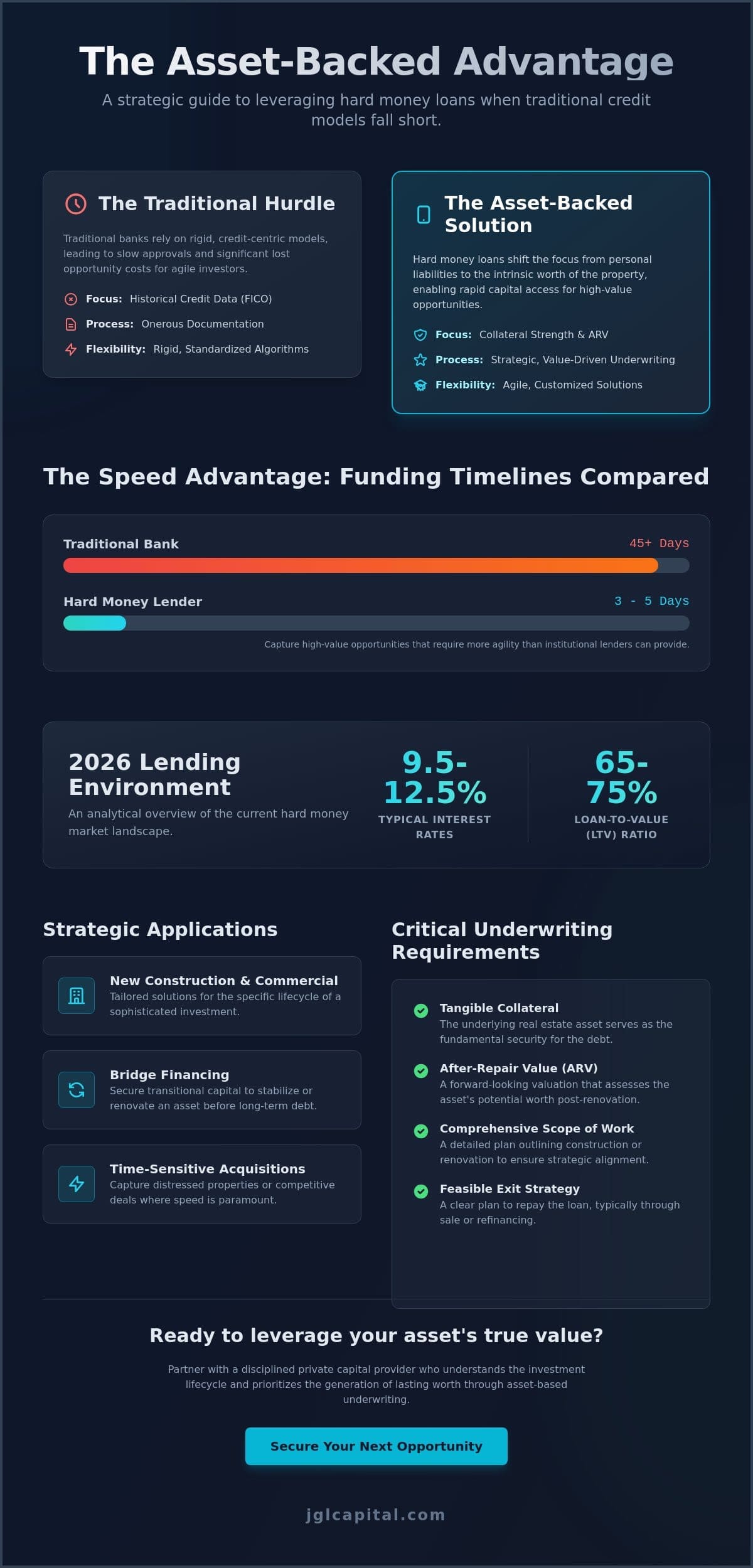
By shifting the focus from personal liabilities to the intrinsic worth of the investment, you’ll gain rapid access to capital, often within three to five days, for new construction, multi-family acquisitions, or bridge financing. We’ll provide an analytical overview of the 2026 lending environment, where interest rates typically range from 9.5% to 12.5% and loan-to-value ratios remain anchored between 65% and 75%. This preview of the current market landscape will help you align your objectives with a partner who understands the investment lifecycle and the generation of lasting worth through disciplined, asset-based underwriting.
Key Takeaways
- Understand how the prioritization of tangible collateral and After-Repair Value allows investors to secure a hard money loan for bad credit when traditional credit metrics prove insufficient.
- Leverage accelerated funding cycles to capture high-value opportunities that require more agility than institutional lenders can provide.
- Analyze the cost of capital by evaluating origination points and interest rates against projected project returns to ensure fiscal efficacy.
- Identify critical underwriting requirements, including the necessity of a comprehensive Scope of Work, to ensure strategic alignment with private capital partners.
- Discover how customized solutions for commercial real estate and new construction projects can be tailored to the specific lifecycle of a sophisticated investment.
Navigating Financing Barriers: The Strategic Role of Hard Money
A Hard money loan is a specialized instrument of bridge financing where the underlying asset, rather than the borrower’s credit history, serves as the fundamental security for the debt. Traditional banking institutions often fail to recognize the latent potential of high-value real estate because their underwriting models are rigidly predicated on historical credit performance. This institutional gap creates a significant friction point for sophisticated investors who possess substantial intellectual capital but face temporary credit constraints. By prioritizing the asset’s intrinsic worth, asset-based capital provides a necessary pathway for those who require liquidity without the delays inherent in traditional mortgage processing.
The Limitations of Traditional Credit Scoring
Standard FICO scores are frequently inadequate metrics for assessing the risk of complex real estate developments or large-scale multi-family acquisitions. These rigid banking regulations often ignore the specific performance metrics of a property or the specialized professional experience of the developer. Many “credit-invisible” professionals possess robust portfolios and successful track records but find themselves sidelined by standardized institutional algorithms. Securing a hard money loan for bad credit allows these professionals to maintain momentum without the constraints of traditional FICO-based mandates. By focusing on asset quality and the feasibility of the exit strategy, disciplined lenders align their objectives with the investor’s vision, ensuring that high-potential projects aren’t stifled by arbitrary credit thresholds.
Hard Money as a Tactical Investment Tool
Sophisticated partners utilize private capital to secure time-sensitive assets, particularly in competitive markets where distressed properties require immediate intervention. Bridge financing serves as a critical component in transitional real estate strategies, providing the necessary runway to stabilize or renovate an asset before seeking long-term institutional debt. For these investors, the immediate availability of liquidity is far more valuable than simple interest rate arbitrage. They understand that the cost of capital is a secondary consideration when compared to the potential for significant value creation through rapid acquisition and repositioning. This disciplined approach to capital ensures that investment cycles remain steady even when traditional credit markets tighten, allowing for the generation of worth through careful, deliberate action.
The Mechanics of Asset-Backed Lending: Prioritizing Collateral
Asset-based lending operates on a fundamental shift in risk assessment, moving the focus from the borrower’s personal financial history to the economic viability of the collateral. While traditional banks utilize credit scores as a proxy for reliability, private capital providers employ prudent risk management practices that prioritize the After-Repair Value (ARV) and current equity positions. This technical approach ensures that the capital allocated is commensurate with the asset’s potential worth. It’s this analytical rigor that makes a hard money loan for bad credit a viable path for high-stakes investors who possess significant property-level opportunities but don’t meet institutional credit mandates.
The Shift from Borrower to Property Risk
When evaluating property risk, lenders analyze both physical characteristics and economic indicators. Professional appraisals are not merely formalities; they’re essential tools for determining precise capital thresholds. By establishing a strict Loan-to-Value (LTV) ratio, typically capped at 65% to 75% in the 2026 market, lenders mitigate potential downside. Robust collateral serves to offset traditional credit deficiencies, providing security that a FICO score cannot replicate. This disciplined property evaluation allows for the preservation of value even in volatile market conditions. Investors seeking to align their capital needs with property potential can explore customized bridge solutions that prioritize asset quality over legacy credit metrics.
Strategic Exit Planning
A successful investment lifecycle depends on a clearly defined pathway to loan maturation. Private lenders prioritize the viability of the exit strategy because the short-term nature of bridge financing requires a definitive conclusion. Whether the objective is liquidation through a sale or stabilization to transition into long-term rental property loans, the exit must be supported by empirical data. Aligning these objectives with your lender creates a collaborative alliance rather than a simple transaction. For those navigating the complexities of a hard money loan for bad credit, a well-documented exit strategy is the most effective way to demonstrate professional competence and secure the necessary capital for high-value acquisitions.
The relationship between LTV and risk mitigation is cumulative. As the investor proves the asset’s worth through a comprehensive Scope of Work or a history of successful management, the risk profile of the loan diminishes. This methodical presentation of principles and philosophies ensures that every claim is qualified. It’s a persuasive rhythm that builds a case for the firm’s competence through a disciplined approach to the creation and preservation of value.
Strategic Underwriting: Essential Criteria for Private Capital
While traditional lenders rely on automated credit scoring, sophisticated private capital providers utilize a more nuanced underwriting process that prioritizes the investor’s professional history and the project’s technical feasibility. Securing a hard money loan for bad credit requires more than just a valuable asset; it demands a clear demonstration of the borrower’s ability to execute the proposed strategy with precision. This alignment of financial objectives between the borrower and the lender ensures that capital is deployed responsibly, fostering a collaborative relationship rather than a merely transactional one. By focusing on the generation of worth through disciplined management, investors can overcome legacy credit constraints and secure the liquidity necessary for high-stakes acquisitions.
A comprehensive Scope of Work (SOW) serves as the cornerstone of this underwriting phase, particularly for those pursuing fix and flip loans. This document provides the granular detail necessary to validate the projected After-Repair Value and ensures that the renovation budget is both realistic and sufficient. Lenders also evaluate liquidity reserves to confirm that the borrower can sustain interest payments and unforeseen contingencies throughout the project lifecycle. This analytical rigor protects both parties, ensuring that the investment is grounded in fiscal reality rather than speculative optimism.
Experience as a Metric of Credibility
Past performance is a primary metric of credibility in the private lending sector. Lenders quantify the track record of the investment team to assess their capacity for managing complex developments or multi-family assets. When an investor demonstrates a history of successful exits, it directly influences the terms of capital allocation, often offsetting the perceived risk of a lower credit score. Maintaining “skin in the game” through a meaningful equity contribution further solidifies this trust. It signals a disciplined commitment to the project’s success and aligns the investor’s interests with the long-term preservation of value.
Documentation for Institutional-Grade Deals
Organizational transparency is essential for streamlining the underwriting process. A professional executive summary should articulate the project’s core philosophy, strategic objectives, and the specific mechanics of the exit strategy. For commercial real estate entities, providing detailed financial statements and entity documents allows the lender to conduct a thorough analysis without the delays typical of institutional banking. This level of preparation reflects a sophisticated approach to resource management. It’s this commitment to professional standards that distinguishes a seasoned investor, allowing them to access asset-backed funding even when traditional credit metrics don’t meet institutional requirements.
Evaluating the Fiscal Efficacy of Hard Money: Rates and ROI
Determining the fiscal efficacy of private lending requires a move from an expense-based perspective to one focused on the net return on investment. While traditional institutions emphasize the minimization of interest rates, seasoned real estate professionals understand that the cost of capital is inextricably linked to the speed of execution and the flexibility of underwriting. For these stakeholders, a hard money loan for bad credit serves as a high-velocity bridge to value creation. By deconstructing the relationship between interest rates and project returns, an investor can determine if the premium paid for asset-backed capital is justified by the capture of a high-yield opportunity.
Points and interest rates function as a direct reflection of the risk profile and the expedited timeline required for funding. In the 2026 market, interest rates typically range from 9.5% to 12.5%, with origination fees established between 1 and 3 points. These costs are the price of a strategic alliance that bypasses the rigid credit constraints of conventional banking. Additionally, the availability of non-recourse or limited-recourse structures provides an essential layer of protection for the investor’s broader portfolio, ensuring that risk is confined to the specific asset under management. This disciplined approach to the preservation of value ensures that the cost of capital doesn’t erode the long-term viability of the investment.
The Opportunity Cost of Traditional Financing
The financial impact of a sixty-day closing delay from a traditional bank often outweighs the higher interest expense of private capital. Rapid funding cycles, which can be completed in as little as three to five days, facilitate the acquisition of undervalued assets that would otherwise be lost to more agile competitors. Balancing a higher cost of capital against increased deal volume allows for more aggressive portfolio expansion. It’s a calculated decision where the “cost of inaction” is the primary risk. If you are prepared to secure a high-value asset, you can evaluate your bridge funding options with a partner focused on long-term growth and integrity.
Transparency in Fee Structures
Disciplined capital management requires a thorough deconstruction of all origination points and administrative costs associated with a loan. Professional lending relationships are built on the foundation of full disclosure and organizational transparency. Meticulous contract review is necessary to ensure that every strategic objective is clearly defined and that no hidden costs compromise the project’s fiscal health. This serious approach to documentation instills trust and ensures that the alignment of objectives remains steady throughout the investment lifecycle. By rejecting speculative trends and focusing on timeless principles of fiscal responsibility, investors can navigate the complexities of a hard money loan for bad credit with confidence.
JGL Capital LLC: Delivering Customized Private Lending Solutions
JGL Capital LLC operates on the foundational belief that high-stakes real estate investment requires more than simple capital provision; it necessitates a sophisticated alignment of strategic objectives and intellectual capital. By offering a hard money loan for bad credit through a lens of analytical rigor, the firm empowers partners to execute high-value transactions that traditional banking structures would typically ignore. Our institutional history, which spans over thirty years, provides the deep-seated expertise required to navigate complex market cycles while maintaining a disciplined focus on the preservation of partner value. This experience is particularly evident in our delivery of highly individualized solutions for commercial real estate loans, where every strategy is meticulously defined to meet the unique requirements of the asset and the stakeholder. We reject the fragmented approach of transactional competitors, choosing instead to function as a quiet expert and a collaborative ally in the creation of lasting legacies.
Our commitment to timeless principles ensures that every claim is qualified and every strategy is grounded in analytical precision. We prioritize the generation of worth over speculative trends, providing a sense of security to high-net-worth stakeholders and professional investment teams. This institutional stability allows our partners to bypass the entry-level constraints of traditional credit markets, moving instead toward a model of liquidity that is predicated on asset quality and professional competence. By framing our activities as a form of high-level strategic alliance, JGL Capital LLC ensures that the alignment of objectives remains steady throughout the entire investment lifecycle.
A Strategic Alliance for Real Estate Developers
Real estate developers require a partner who functions as a disciplined steward of transitional capital, especially when project timelines are compressed. Our approach to new construction loans involves tailoring funding disbursements to project-specific milestones, ensuring that liquidity remains available exactly when the development lifecycle demands it. This methodical pace suggests a firm that takes the time to conduct thorough analysis, valuing precision over speed while still maintaining the agility necessary to secure high-value opportunities. We focus on building lasting legacies through careful, deliberate action, ensuring that each development project is positioned for long-term growth and fiscal stability.
Initiating Your Capital Allocation Strategy
The transition toward asset-backed capital begins with a consultative approach to loan origination. We conduct a thorough internal review that prioritizes precision and reliability over the aggressive self-promotion common in more transactional sectors of the market. This process ensures that every hard money loan for bad credit we facilitate is backed by a realistic exit strategy and a comprehensive understanding of the asset’s potential. We invite you to engage with a seasoned expert at JGL Capital LLC for a confidential portfolio review, allowing us to align our intellectual capital with your strategic objectives. By initiating this collaborative relationship, you can secure the customized private lending solutions necessary to preserve and enhance the value of your real estate holdings.
Advancing Your Investment Portfolio Through Strategic Capital Allocation
The transition from traditional, credit-dependent borrowing to asset-backed capital allocation represents a fundamental shift in real estate strategy. By prioritizing the intrinsic value of the collateral and the viability of the exit strategy, you can bypass the institutional barriers that often stifle growth. Utilizing a hard money loan for bad credit isn’t a compromise; it’s a tactical decision to secure high-value assets with speed and precision. This disciplined approach ensures that your investment decisions are grounded in property potential rather than legacy credit metrics, allowing for the consistent generation of worth in a competitive market.
With over thirty years of collective industry expertise, JGL Capital LLC serves as a disciplined steward for those navigating transitional real estate strategies. We specialize in high-value asset-backed financing, offering customized lending structures that cater to the specific needs of professional investors. Our firm’s philosophy is rooted in stability and a serious approach to the preservation of value. We invite you to consult with our strategic capital partners today to begin a collaborative relationship focused on the generation of worth. We’re prepared to help you secure the high-value opportunities that define your investment legacy.
Frequently Asked Questions
Can I qualify for a hard money loan with a credit score below 500?
Qualification is possible because the primary security for the debt rests in the property’s equity rather than the borrower’s personal credit history. While traditional institutions impose absolute FICO thresholds, asset-based lenders prioritize the After-Repair Value and the strength of the exit strategy. This focus allows professional investors to secure a hard money loan for bad credit even when their personal credit profile reflects historical challenges or temporary constraints.
How does the property value influence the terms of a hard money loan?
Property value serves as the fundamental anchor for all lending terms, specifically through the application of Loan-to-Value (LTV) and Loan-to-Cost (LTC) ratios. Lenders typically finance between 65% and 75% of the property’s appraised value to mitigate downside risk. A higher equity position or a more robust After-Repair Value often results in more favorable interest rates and origination fees, as the collateral provides greater security for the allocated capital.
What is the typical duration for a hard money loan for real estate investors?
These instruments are structured as short-term bridge financing, with typical durations ranging from 6 to 36 months. This timeline provides sufficient runway for property stabilization, renovation, or construction before the investor transitions to long-term debt or liquidates the asset. Because these loans are designed for specific project lifecycles, they prioritize flexibility over the multi-decade terms associated with traditional residential mortgages.
Are hard money loans available for new construction projects with bad credit?
Asset-based capital is frequently utilized for new construction projects, provided the development demonstrates a clear path to value generation. Lenders evaluate the project’s technical feasibility and the developer’s professional experience rather than personal credit scores. Securing a hard money loan for bad credit in the construction sector requires a detailed Scope of Work and a realistic budget that accounts for all phases of the build.
How quickly can JGL Capital fund an asset-backed bridge loan?
Funding cycles for asset-backed bridge loans are significantly accelerated compared to institutional banking, with the process often concluding within three to five days. This speed is achieved through a streamlined underwriting process that focuses on property appraisal and title clarity rather than exhaustive personal financial audits. Such agility allows professional investors to capture time-sensitive opportunities in competitive markets where traditional financing would be too slow to execute.
What are the main differences between hard money and traditional bank financing?
The primary distinction lies in the underwriting philosophy; traditional banks prioritize borrower credit and income, while hard money lenders focus on the intrinsic value of the real estate asset. Additionally, private capital offers significantly faster funding timelines and greater structural flexibility at a higher cost of capital. While banks require extensive documentation, asset-based lenders emphasize the property’s equity and the viability of the investor’s exit strategy.
Do I need to provide personal income tax returns for a hard money loan?
Personal income tax returns are generally not the primary focus of an asset-based underwriting process. Because the loan is secured by the property’s value, lenders are more concerned with the asset’s cash flow potential or its projected value upon completion. This reduced documentation requirement is a hallmark of professional private lending, allowing investors to maintain privacy and speed while focusing on project-level performance metrics.
What happens if I cannot meet the exit strategy deadline?
Failure to meet an exit deadline requires immediate and transparent communication with the lender to explore potential extensions or restructuring options. While these loans have definitive maturation dates, disciplined lenders often value collaborative relationships and may offer solutions if the project remains viable. It’s essential to maintain a realistic timeline from the outset to preserve the alignment of objectives and protect the underlying equity in the asset.