

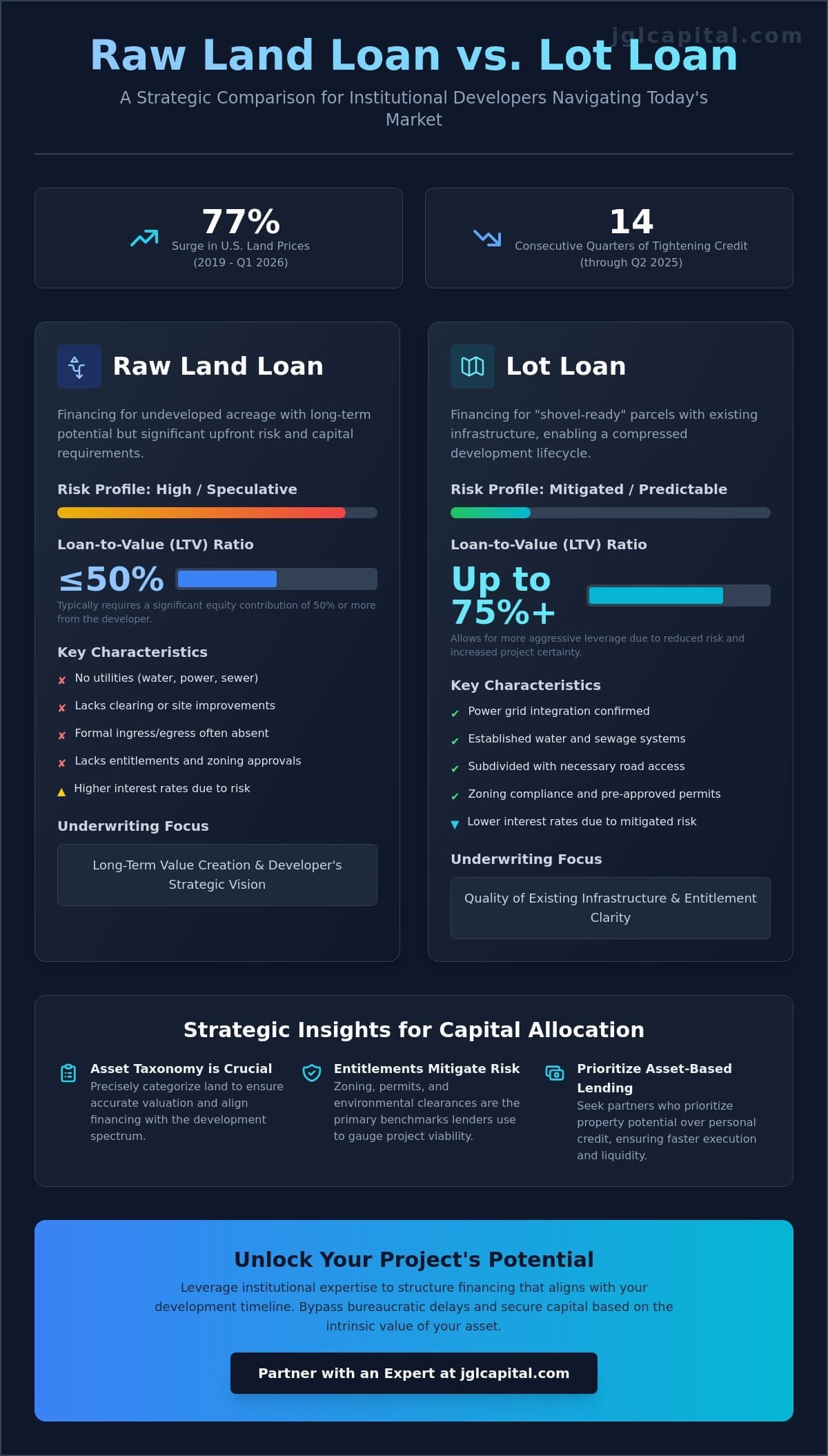
The staggering 77% surge in United States land prices between early 2019 and the first quarter of 2026 has fundamentally restructured the financial landscape for institutional developers. You’ve likely encountered the friction of traditional lending, where bureaucratic delays and high down payment requirements for undeveloped assets often clash with aggressive acquisition schedules. Understanding the nuances of a raw land loan vs lot loan is no longer a peripheral concern; it’s a requisite for sophisticated capital preservation and project execution. As credit conditions have tightened for 14 consecutive quarters through the second quarter of 2025, the distinction between raw acreage and a shovel-ready lot represents a critical divergence in risk and underwriting.
This analysis provides the framework to navigate these complexities by examining the specific capital stack requirements and interest rate environments of May 2026. We’ll demonstrate how to align your financing with development timelines while securing asset-backed funding that prioritizes project viability over personal credit metrics. By the conclusion of this strategic overview, you’ll understand how to optimize your capital allocation across different land types to ensure your next acquisition is supported by a disciplined, expert partner rather than a transactional lender.
Key Takeaways
- Establish a precise taxonomy for land assets to ensure accurate categorization and valuation within a professional investment portfolio.
- Analyze the divergence in Loan-to-Value (LTV) ratios and interest rate structures when evaluating a raw land loan vs lot loan for high-stakes development.
- Understand how entitlements, including zoning and environmental clearances, serve as the primary benchmarks for mitigating risk in the institutional underwriting process.
- Evaluate strategic capital allocation methods that utilize private funding to maintain liquidity and bypass the bureaucratic delays of traditional banking.
- Discover how asset-based lending frameworks prioritize the intrinsic potential of a property and the strategic vision of the developer over conventional credit metrics.
Conceptualizing Land Assets: Definitions and the Development Spectrum
For the institutional investor, land is not merely a static asset but a variable in a complex equation of risk and potential yield. Establishing a precise taxonomy within a professional portfolio is the first step toward effective capital deployment. The distinction between raw acreage and developed parcels dictates the entire trajectory of the real estate development process, influencing everything from underwriting rigor to the final exit strategy. When analyzing the choice of a raw land loan vs lot loan, one must view these assets through the lens of their current state of preparation and their proximity to vertical construction.
Raw land represents the most nascent stage of the development spectrum. It’s characterized by a total absence of utilities, clearing, or established infrastructure. Conversely, a lot is a parcel that has been subdivided and improved with necessary road access and utility tie-ins. This classification is not merely semantic. It fundamentally determines the weighted average cost of capital (WACC) for a project, as lenders price the inherent uncertainty of undeveloped dirt differently than they do for shovel-ready sites.
The Anatomy of Raw Land Investments
Investing in raw land requires a disciplined approach to long-term value creation. These assets often lack basic entitlements and formal ingress or egress, presenting significant hurdles for immediate use. Investors must weigh the potential for substantial appreciation against the persistent carry costs of taxes and maintenance. Within a sophisticated strategy, raw land often functions as a strategic land bank. It allows developers to secure a footprint in emerging markets before the surrounding infrastructure drives prices to a premium. However, the lack of improvements means these assets are typically viewed as the highest risk tranche by traditional institutions.
Lot Loans and the ‘Shovel-Ready’ Advantage
Lot loans cater to “finished lots” that are positioned for immediate vertical progress. These parcels offer a compressed development lifecycle because the heavy lifting of horizontal infrastructure is already complete. Underwriting for these assets focuses heavily on the quality of existing connectivity, including:
- Power Grid Integration: Confirmed capacity for the intended density.
- Hydrological Infrastructure: Established water lines and sewage systems.
- Zoning Compliance: Pre-approved permits that align with the project’s vision.
Because the primary risks associated with environmental clearances and utility extensions have been mitigated, lot loans typically command lower interest rates than their raw land equivalents. This increased certainty allows for more aggressive leverage and a more predictable capital stack, making them a preferred vehicle for developers ready to break ground. Understanding where a property sits on this spectrum is essential for any investor seeking to balance risk with the necessity of timely execution.
Comparative Analysis: Raw Land Loan vs. Lot Loan Structures
The structural differentiation between a raw land loan vs lot loan is primarily a function of risk mitigation and capital liquidity. Lenders analyze the capital stack to ensure that the developer’s equity is sufficient to weather the volatility inherent in the pre-development phase, where unforeseen geological or regulatory challenges can arise. Lenders view these instruments through the lens of asset maturity; the closer a parcel is to its final utility, the more favorable the financing terms become. These structures typically favor shorter amortization periods or interest-only terms, culminating in a balloon payment that aligns with the anticipated project exit.
Capital Requirements and Down Payment Thresholds
When contrasting the requirements of a raw land loan vs lot loan, the divergence in Loan-to-Value (LTV) ratios serves as a primary indicator of the lender’s perceived risk. Raw land acquisitions frequently necessitate a 50% equity contribution. This high threshold accounts for the speculative nature of un-entitled acreage. Conversely, improved lots in established subdivisions typically operate within a 20% to 30% down payment range. To optimize the capital stack, institutional investors often leverage cross-collateralization, using existing equity in other portfolio assets to reduce cash-on-hand requirements.
Interest Rates and the Premium for Undeveloped Assets
The risk premium attached to undeveloped land reflects the uncertainty of future entitlements and infrastructure costs. As developers assess the environmental impacts of land use, they must recognize that regulatory compliance directly influences the asset’s liquidity. Private money lenders often prioritize the velocity of capital, seeking deals where the transition to vertical construction is clearly defined. This focus on speed means that while raw land carries higher rates, a well-structured land loan can facilitate a rapid acquisition that traditional banks might otherwise delay.
The role of the exit strategy is paramount in this context. A lender’s willingness to offer competitive points and rates is contingent upon a clear path to repayment, whether through a construction loan refinance or the sale of finished parcels. Amortization schedules for these loans are rarely standard; they often feature interest-only periods that preserve cash flow during the entitlement phase. This flexibility is critical for institutional investors who must manage liquidity across multiple projects simultaneously. Without a documented exit, the cost of capital escalates, reflecting the lender’s potential burden of managing an illiquid asset.
Underwriting Frameworks: Navigating Risk and Entitlements
Traditional banking institutions typically view land as a dormant asset, one that lacks the immediate cash-flow generation required to service debt through conventional means. This perception creates a significant hurdle for developers who require capital for acquisition before vertical construction begins. When evaluating a raw land loan vs lot loan, the underwriter’s focus shifts from the current state of the dirt to the legal and physical viability of the proposed project. Institutional underwriting relies heavily on the concept of Highest and Best Use (HBU), an analytical framework that determines which use of the property is physically possible, legally permissible, and maximally productive.
The complexity of land use and zoning laws often dictates the speed and success of the underwriting process. While traditional lenders might fixate on a borrower’s personal debt-to-income ratio, asset-based lenders prioritize the property’s future value and the developer’s ability to navigate the entitlement maze. It’s a forward-looking approach. By focusing on the intrinsic worth of the land once it’s fully permitted, these lenders provide a form of strategic alliance that aligns with the developer’s long-term vision rather than just their current balance sheet.
The Entitlement Process as a Value Catalyst
Moving a parcel from raw acreage to entitled status is the single most effective way to compress risk and enhance value. This transition often involves exhaustive environmental impact studies, soil testing, and hydrological assessments to ensure the land can support the intended density. In the context of a raw land loan vs lot loan, the presence of a development agreement with the municipality can dramatically shift the loan-to-value ratio in the borrower’s favor. Navigating these municipal requirements isn’t just a bureaucratic necessity; it’s a value-creation exercise that transforms speculative dirt into a bankable asset.
Exit Strategies: The Key to Loan Approval
A credible path to repayment is the cornerstone of any successful institutional loan application. Lenders aren’t just looking for a high credit score; they’re looking for a robust development plan that outlines exactly how the debt will be retired. This typically involves refinancing the acquisition debt into a construction loan or executing a phased sale of finished lots. Bridge financing often serves as the critical link during this transition, providing the liquidity needed to reach the next milestone. It’s the strength of the exit strategy, rather than the borrower’s personal income, that ultimately secures the most favorable terms in a high-stakes environment.
Strategic Capital Allocation and Execution for Developers
The tactical deployment of capital in land acquisition requires an acute understanding of how debt instruments facilitate specific project lifecycles. Institutional developers don’t merely evaluate interest rates; they assess the strategic alignment of the financing vehicle with their anticipated development timeline. In a market where land prices surged 77% between early 2019 and the first quarter of 2026, the ability to deploy capital rapidly has become a defining competitive advantage. Deciding between a raw land loan vs lot loan often depends on whether the investor is prioritizing long-term land banking or immediate vertical progress. Structuring this debt correctly ensures that cash flow remains unburdened during the critical pre-development and entitlement phases, where liquidity is most vulnerable to exhaustion.
The Speed of Private Money in Land Acquisition
Securing prime parcels in competitive markets demands a level of agility that traditional banking institutions rarely provide. Speed to close is a critical differentiator, as sellers often prioritize certainty of execution over the highest offer. By utilizing private capital, sophisticated investors can bypass the rigid debt-to-income requirements that often stall conventional approvals. This approach allows for the immediate seizure of opportunities while traditional financing remains in a state of bureaucratic review. Private money acts as a bridge, providing the necessary liquidity to secure the asset without the friction of exhaustive personal credit underwriting, focusing instead on the property’s intrinsic potential and the developer’s established track record. It’s a method that values the viability of the project over the static metrics of the borrower.
Transitioning to New Construction Financing
Successful execution involves a seamless transition from the initial land acquisition phase to active development. Integrating land loans with new construction loans allows for a cohesive capital stack that supports the project from inception to completion. Once vertical construction commences, the management of the draw schedule becomes paramount. This ensures that capital is released in alignment with verified construction milestones, maintaining the project’s momentum without over-extending the lender’s exposure. For those managing complex multi-family or commercial portfolios, optimizing this transition is essential for preserving equity and maximizing internal rates of return. A well-structured capital stack considers the entire lifecycle, from the first survey to the final occupancy permit. If you’re ready to advance your next project with a disciplined partner, consider exploring a tailored Bridge Loan to facilitate your acquisition.
The JGL Capital Approach: Institutional Expertise in Land Financing
JGL Capital operates as a disciplined steward for institutional investors who recognize that land acquisition is the foundation of long-term value preservation. We understand that the choice between a raw land loan vs lot loan is a high-stakes strategic decision that requires more than a simple spreadsheet analysis. Our organization functions as a quiet expert, relying on over thirty years of intellectual capital to provide a sense of security in complex transactions. Unlike traditional banks that often struggle with the illiquidity of undeveloped assets, our philosophy of asset-based lending prioritizes the intrinsic potential of the property and the strategic vision of the developer. This approach eliminates the administrative friction and bureaucratic delays that frequently compromise time-sensitive acquisitions.
Our role is that of a seasoned partner rather than a transactional service provider. By focusing on the analytical rigor of the project itself, we’re able to move with a level of precision that matches the gravity of high-stakes management. We value integrity and long-term growth above all else, ensuring that every capital allocation is meticulously balanced against the project’s specific risk tranche. This commitment to excellence allows our partners to focus on execution while we manage the complexities of the capital stack.
Customized Solutions for Sophisticated Partners
We believe that every development project requires a bespoke financial structure. Our team tailors commercial real estate loans to align with unique project milestones, ensuring that liquidity is available when it’s most critical. This collaborative relationship is built on a foundation of transparency and shared objectives. By leveraging our extensive network, we provide competitive bridge and hard money solutions that address the specific needs of transitional land assets. Whether you’re navigating the nuances of a raw land loan vs lot loan, our solutions are designed to support your individual objectives with surgical precision.
Initiating Your Strategic Alliance
Engaging with JGL Capital begins with a methodical presentation of your development plans and core philosophies. We favor a disciplined approach where every claim is qualified and every strategy is clearly defined. To facilitate a rapid and sophisticated review of your capital needs, we encourage developers to prepare a comprehensive proposal that outlines the project’s “Highest and Best Use” and a credible exit strategy. Our team conducts a thorough analysis of these components to ensure an alignment of worth and responsibility. When you’re ready to secure a partner that values your vision as much as your collateral, we invite you to contact JGL Capital to begin a high-level strategic alliance focused on the generation of lasting value.
Advancing Your Land Acquisition Strategy with Disciplined Capital
The strategic distinction between a raw land loan vs lot loan defines the risk profile of your entire development portfolio. As land prices surged 77% between early 2019 and the first quarter of 2026, the necessity for precise capital allocation has never been more acute. Sophisticated investors must weigh the long-term appreciation of un-entitled acreage against the immediate velocity of shovel-ready lots. Navigating this spectrum requires a transition from the bureaucratic delays of conventional lending to a more agile, asset-centric framework that prioritizes project viability over static credit metrics.
Achieving project milestones depends on a financing partner that understands the gravity of high-stakes management. JGL Capital delivers this through specialized asset-based underwriting and a national reach characterized by institutional-grade speed. With over 30 years of industry expertise, we act as a disciplined steward for your capital requirements. Partner with JGL Capital for your next strategic land acquisition. We’re committed to building lasting legacies through collaborative relationships and the generation of significant worth. Your next development deserves the stability of a seasoned expert.
Frequently Asked Questions
What is the primary difference between a raw land loan and a lot loan for an investor?
The distinction lies in the development maturity and infrastructure readiness of the underlying asset. A raw land loan applies to entirely undeveloped acreage that lacks basic utilities, clearing, and established ingress or egress. Conversely, a lot loan is utilized for parcels that have been subdivided and improved with necessary road access and utility tie-ins, making them shovel-ready for vertical construction. This taxonomy is essential for institutional investors when evaluating the risk profile of a raw land loan vs lot loan for their portfolios.
Why do private money lenders require a higher down payment for raw land?
Lenders demand increased equity contributions to mitigate the speculative risk associated with un-entitled and unimproved property. Raw land typically requires a 30% to 50% down payment because it lacks immediate cash flow and faces significant uncertainty regarding future entitlements or environmental clearances. Since the path to a viable exit is longer and more complex than with improved lots, a substantial equity stake ensures that the developer remains committed to the project’s long-term objectives.
Can a land loan be converted into a construction loan once the project begins?
Land acquisition financing is frequently refinanced into a construction loan once the entitlement phase concludes and vertical progress is ready to commence. This transition allows the developer to retire the initial acquisition debt and access a new capital stack designed for the build-out phase. Managing this integration seamlessly is a hallmark of sophisticated project execution, as it aligns the debt structure with the evolving needs of the development lifecycle and the verified construction milestones.
What are the common interest rate ranges for private land acquisition loans in 2026?
As of May 2026, interest rates for land acquisition typically range from 4% to 10%, reflecting a risk premium above traditional mortgage rates. Specific market data from May 22, 2026, indicates that 3/1 adjustable-rate mortgages for building lots carry interest rates around 7.25%, while raw land variants are positioned near 8.25%. These figures fluctuate based on the asset’s development status and the lender’s assessment of the project’s intrinsic worth and legal permissibility.
How does zoning affect the underwriting process for a lot loan?
Zoning serves as a critical benchmark in determining the “Highest and Best Use” of a parcel, which directly influences its appraised value and loan eligibility. Underwriters scrutinize existing permits and development agreements to ensure the project aligns with municipal requirements and land use laws. A lot with established zoning for its intended density presents a lower risk profile, often resulting in more favorable loan-to-value ratios and compressed interest rate pricing compared to un-entitled acreage.
Is a personal credit score the deciding factor for land loan approval at JGL Capital?
Personal credit metrics are secondary to the property’s future potential and the developer’s strategic vision within our asset-based lending framework. We prioritize the viability of the project and the strength of the documented exit strategy over static borrower scores. This approach allows us to act as a disciplined partner for sophisticated investors who may have complex financial structures but possess high-quality land assets with significant development upside.
What documentation is required to prove a viable exit strategy for land financing?
Developers must provide a methodical presentation of their development plans, including site surveys, environmental impact studies, and municipal permits. Proof of a credible repayment path typically involves detailed projections for a construction loan refinance or a phased sale of finished parcels. Lenders seek clarity on how the debt will be retired, valuing a robust operational philosophy and a clear timeline more than marketing hyperbole or speculative growth claims.
How long does the approval process typically take for a private land bridge loan?
Private lenders prioritize institutional-grade speed, often completing the underwriting and approval process in a fraction of the time required by traditional banks. While conventional institutions may take months to navigate bureaucratic reviews, a bridge loan can often be secured within days or weeks. This agility is a critical differentiator for developers who need to close quickly on prime parcels in competitive markets where delays can compromise the entire acquisition strategy.