

Achieving 100% leverage within the contemporary real estate market isn’t a consequence of identifying a lenient lender, but rather a direct result of sophisticated asset selection and strategic equity positioning. Although the median purchase price for flipped properties reached a record $259,700 in 2025, many investors find that traditional banking institutions remain prohibitively restrictive and ill-suited for the pace of modern acquisitions. Mastering the specific fix and flip loan requirements for investors is essential for those who intend to expand their portfolios without being constrained by the limitations of personal liquidity.
You likely understand the frustration of encountering opaque fee structures and capital constraints that hinder your ability to capitalize on market opportunities as they arise. This article provides a disciplined framework for utilizing institutional private capital to secure 100% financing for both acquisition and renovation. We’ll examine the structural requirements for zero-down deals, analyze the strategic use of cross-collateralization to bridge equity gaps, and outline the criteria for identifying a reliable capital partner who prioritizes the preservation of value and professional alignment over mere transactional volume.
Key Takeaways
- Understand the transition from traditional credit-centric lending to asset-based equity models that facilitate maximum leverage for sophisticated portfolios.
- Explore the strategic implementation of cross-collateralization as a primary mechanism to eliminate personal cash requirements for property acquisitions.
- Evaluate the essential fix and flip loan requirements for investors seeking to align with institutional capital partners rather than transactional hard money lenders.
- Analyze the nuanced relationship between high-leverage capital structures and the optimization of the Internal Rate of Return within high-stakes management.
- Master the development of a professional investment prospectus designed to satisfy rigorous institutional underwriting and contractor vetting protocols.
The Mechanics of No-Money-Down Fix and Flip Funding
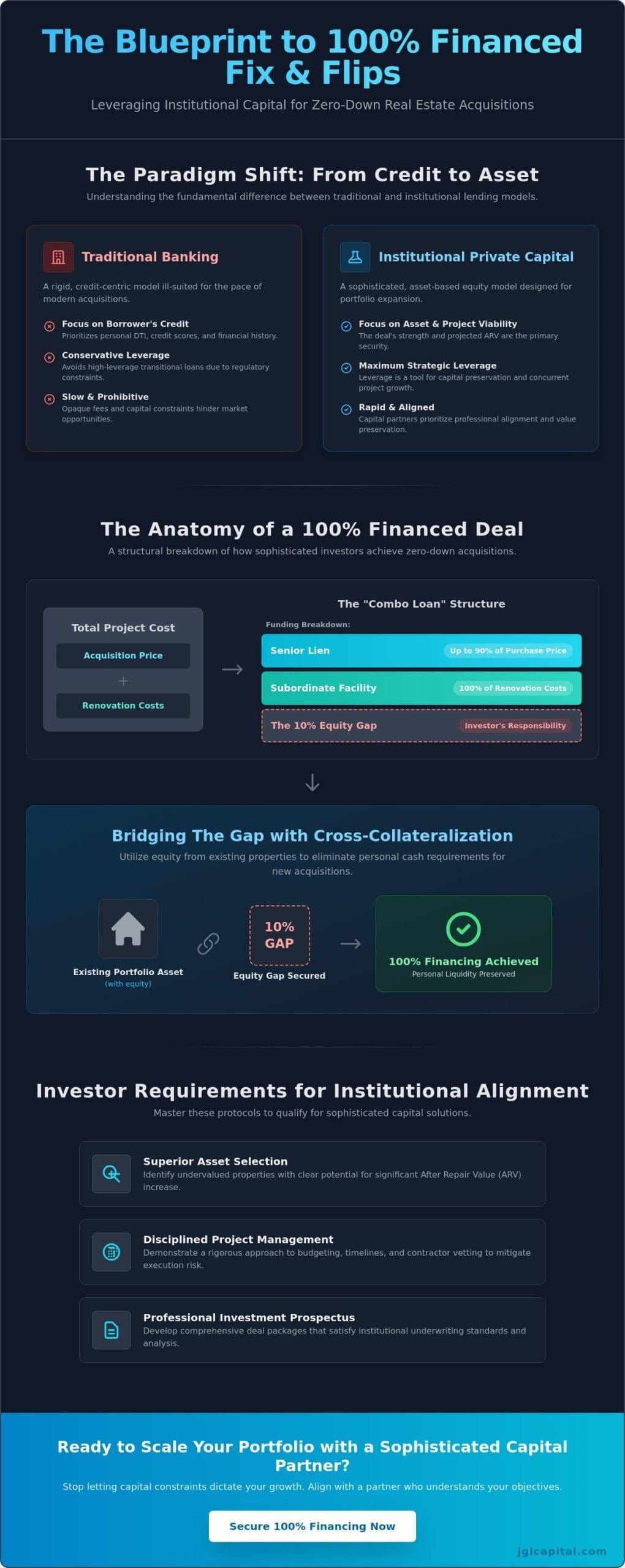
Institutional private capital operates on a philosophical foundation that is fundamentally distinct from the rigid, credit-centric models employed by traditional retail lending institutions. While conventional banks prioritize a borrower’s personal debt-to-income ratios and historical credit performance, sophisticated capital partners focus on the intrinsic value and projected performance of the specific real estate asset. This paradigm shift represents a move toward asset-based equity requirements, where the strength of the deal itself serves as the primary security for the investment. Within this framework, 100% financing is not a product of lax underwriting; it is a calculated response to superior asset selection and disciplined project management.
Traditional financial institutions generally avoid high-leverage transitional loans because their regulatory mandates require conservative risk-weighting and a preference for stabilized, cash-flowing assets. These organizations aren’t structured to evaluate the complexities of the practice of flipping properties, which involves rapid value appreciation through physical renovation. Consequently, the role of the private money broker has become essential. These intermediaries act as strategic architects, sourcing specialized capital from institutional pools that understand the nuances of transitional real estate and can provide the liquidity necessary for rapid portfolio expansion. Meeting the fix and flip loan requirements for investors in this elite tier requires a shift in perspective from personal financial history to the rigorous analysis of project viability.
Understanding the 100% Financing Framework
It’s critical to distinguish between financing 100% of the purchase price and financing 100% of the total project cost, which includes both acquisition and renovation. Institutional lenders typically utilize the After Repair Value (ARV) as their primary metric for determining leverage, often capping the total loan amount at a specific percentage of the projected terminal value. By focusing on the asset quality and the margin between the acquisition cost and the ARV, lenders can mitigate risk even in zero-down scenarios. This structure ensures that the lender’s position is protected by the equity created through the renovation process, rather than relying solely on the borrower’s initial cash injection.
The Evolution of Private Capital in 2026
The current lending environment reflects a commitment to disciplined stewardship, where capital is allocated based on the alignment of strategic objectives between the investor and the funding partner. Leverage is utilized as a sophisticated tool for capital preservation and growth, allowing investors to maintain liquidity for multiple concurrent projects while the lender secures its interest in high-quality, value-add real estate. As fix and flip loan requirements for investors continue to evolve, the emphasis remains on the generation of worth through meticulous execution and the mitigation of speculative risk through analytical rigor.
Strategic Structures for 100% Financing in Real Estate
Achieving 100% leverage in 2026 demands a departure from elementary lending practices toward a more nuanced understanding of capital allocation. For the seasoned professional, understanding how fix and flip loans work serves as a baseline; however, the execution of zero-down acquisitions requires the integration of multiple debt layers. This strategic approach often involves cross-collateralization, where the equity in existing holdings functions as a substitute for a traditional cash down payment. By securing a lien against a stabilized asset within a portfolio, an investor can satisfy the fix and flip loan requirements for investors without depleting liquid reserves, thereby maintaining the agility necessary to secure additional opportunities.
The implementation of combo loans represents another sophisticated mechanism for achieving total leverage. These structures typically bifurcate the funding into two distinct tranches: a senior lien for the property acquisition and a subordinate facility dedicated to 100% of the renovation costs. While many institutional lenders provide up to 90% of the purchase price, the inclusion of a second-position lien or gap funding can bridge the remaining 10% equity requirement. This multi-layered debt stack ensures that the investor’s personal capital remains unencumbered, allowing for the simultaneous management of multiple projects across diverse geographic markets.
Cross-Collateralization: Leveraging the Portfolio
Cross-collateralization involves a blanket lien that encompasses both the subject property and one or more properties already owned by the borrower. This structure is particularly effective for investors with significant equity in rental portfolios or recently completed projects that haven’t yet been refinanced. The legal and structural requirements for these liens are rigorous, necessitating a clear title and a conservative Loan-to-Value (LTV) ratio across the entire collateral pool. It’s a disciplined method of recycling existing worth to fuel new growth, though it requires a careful assessment of how individual project volatility might impact the broader portfolio.
Gap Funding and Mezzanine Financing
Secondary capital plays a pivotal role in 100% leverage deals by providing the “top-off” funding that senior lenders typically avoid. Aligning the objectives of primary and secondary capital providers is essential to ensure that the debt service remains manageable and the project’s terminal value supports the entire capital stack. For the sophisticated investor, the cost of this secondary debt is often outweighed by the increased Internal Rate of Return (IRR) achieved through zero-down financing. For those seeking to align with a partner that values intellectual capital over simple transactions, exploring bespoke funding structures provides a path toward sustainable growth and long-term value creation.
- Asset-Based Security: Using property equity rather than cash liquidity.
- Tranche Optimization: Allocating specific debt layers to acquisition and rehab phases.
- Strategic Agility: Preserving cash reserves for unforeseen market shifts.
Navigating the Risks of High-Leverage Capital Allocation
The allocation of high-leverage capital requires a level of analytical rigor that transcends basic project estimation. While conventional wisdom suggests that increased debt levels inherently correlate with elevated risk, sophisticated partners recognize that risk is a function of asset quality and execution precision. A project secured at 100% leverage with a substantial margin between acquisition and terminal value often presents a more stable profile than a low-leverage deal with marginal returns. Understanding the specific fix and flip loan requirements for investors in this context involves a comprehensive analysis of how debt structures influence the preservation of capital and the generation of worth.
Managing debt service coverage in a transitional national market demands a disciplined approach to cash flow. It’s essential to recognize that high leverage amplifies both gains and potential losses, making the accuracy of the initial underwriting paramount. Institutional lenders prioritize the alignment of interests, ensuring that the borrower’s exit strategy is not just a theoretical projection but a battle-tested plan for divestment. This level of scrutiny distinguishes professional capital allocation from speculative lending, reinforcing a sense of security for all stakeholders involved in the transaction.
Leverage vs. Profitability: The Institutional Perspective
Institutional lenders view leverage as a mechanism for optimizing the Internal Rate of Return (IRR) rather than a simple substitute for liquidity. By utilizing zero-down funding, an investor can preserve personal cash reserves to execute multiple concurrent projects across diverse markets. This isn’t just about scaling; it’s a strategic move to spread risk. While standard consumer guidance on mortgages emphasizes the reduction of personal debt, the institutional framework focuses on the cost of capital versus the opportunity cost of idle liquidity. Strategic capital preservation serves as a vital defense against unexpected shifts in market dynamics.
Common Pitfalls in High-Leverage Flipping
Despite the advantages of high-leverage structures, certain pitfalls can compromise the integrity of a deal. The most significant threat is the overestimation of the After Repair Value (ARV), which serves as the anchor for the entire capital stack. If the terminal value is miscalculated, the equity cushion evaporates. Additionally, failing to account for extended renovation timelines can erode profit margins through increased carrying costs. Even when a project satisfies the fix and flip loan requirements for investors and secures 100% funding, maintaining a robust liquidity reserve is essential. This reserve provides the necessary friction for managing contractor delays or material cost fluctuations without jeopardizing the project’s solvency.
- IRR Optimization: Reducing capital outlay to amplify percentage-based returns.
- Market Diversification: Spreading risk across multiple assets and regions.
- Disciplined Exit: Establishing firm timelines for project completion and divestment.
Preparing for Institutional Underwriting and Due Diligence
Institutional underwriting represents a rigorous vetting process that distinguishes professional capital allocation from speculative lending. For the sophisticated investor, the submission of a project isn’t merely a request for funding but the presentation of a comprehensive investment prospectus that articulates the strategic alignment between the asset and the capital provider. This documentation serves as a linguistic signature of the borrower’s competence, reflecting a disciplined approach to the creation of worth. A successful prospectus must detail the anatomy of the deal with meticulous precision, providing the analytical rigor required to instill trust in high-net-worth stakeholders and institutional partners.
Establishing credibility through a proven track record remains a cornerstone of the underwriting process. Lenders prioritize partners who demonstrate a history of successful execution, as this professional history mitigates the perceived risk of high-leverage structures. While individual project merits are paramount, the investor’s established history functions as intellectual capital, signaling a commitment to timeless principles of resource management. For those ready to present an institutional-grade deal, the team at JGL Capital facilitates the alignment of strategic objectives through bespoke funding solutions.
The Deal Package: Articulating Value to Capital Partners
A professional deal package must include a detailed Scope of Work (SOW), a comprehensive renovation budget, and a realistic project timeline. These documents allow the lender to evaluate the feasibility of the proposed improvements and ensure that the renovation strategy is commensurate with the projected After Repair Value (ARV). To satisfy the specific fix and flip loan requirements for investors, one must present comparable sales data with analytical rigor, utilizing precise industry-specific language to justify the terminal value. The borrower executive summary serves as the narrative anchor, defining the strategic vision for the asset and the anticipated generation of value.
The Underwriting Process for Asset-Backed Loans
The underwriting phase involves a methodical evaluation of the renovation plan, contractor vetting processes, and structural due diligence. Institutional lenders often require third-party appraisals to validate high-leverage requests, ensuring that the asset’s intrinsic worth provides sufficient security for the capital stack. Environmental and structural assessments are frequently mandatory for national investment properties to identify potential liabilities that could compromise the project’s solvency. Once the analysis is complete, the finalization of the term sheet involves a precise articulation of points, interest rates, and draw schedules, creating a steady rhythm for capital disbursement throughout the project lifecycle.
JGL Capital: Facilitating Sophisticated Capital Solutions
JGL Capital LLC operates on the principle that capital allocation is a form of high-level strategic alliance rather than a simple service provision. This philosophy prioritizes the alignment of long-term objectives over the fleeting nature of transactional lending. With an established history spanning three decades, the firm relies on its extensive intellectual capital to source bespoke funding structures that satisfy the most rigorous fix and flip loan requirements for investors. By functioning as a disciplined steward of value, JGL Capital LLC ensures that every financing arrangement is grounded in analytical rigor and a commitment to the preservation of stakeholder worth.
The firm’s approach is characterized by a streamlined, asset-focused underwriting process designed specifically for national investors who manage high-stakes portfolios. This methodology bypasses the traditional constraints of retail banking, focusing instead on the intrinsic performance metrics of the real estate asset. It’s a system built for those who value precision and stability, ensuring that capital is deployed with the same level of care that the investor applies to their own acquisitions.
A Disciplined Approach to Private Money Brokerage
The advantage of partnering with JGL Capital LLC lies in our access to a robust national network of institutional capital providers, each vetted for their stability and professional alignment. This network allows for the customization of loan structures to accommodate the complexities of both residential flips and multi-family acquisitions. For a localized perspective on market-specific nuances, investors should consult our strategic guide to fix and flip loans, which provides deeper insight into executing these strategies within high-demand environments. By tailoring the financing to the specific needs of the project, we ensure that the capital stack remains optimized for maximum performance and the fix and flip loan requirements for investors are satisfied with ease.
Partnering for Long-Term Value Creation
Our commitment to our partners extends beyond the provision of bridge loans; we strive to provide comprehensive portfolio financing solutions that foster sustainable growth. JGL Capital LLC serves as a steady steward of your investment vision, offering a level of discretion and expertise that is rare in a crowded marketplace. As your portfolio expands into larger, more sophisticated assets, you can explore our commercial real estate loan solutions for projects that require a higher register of capital allocation. We remain focused on building lasting legacies through careful, deliberate action, ensuring that every strategic objective is met with precision and professional integrity.
Advancing Your Portfolio Through Strategic Capital Alliances
Mastering the fix and flip loan requirements for investors is the foundational step toward a high-leverage strategy that prioritizes capital preservation over simple acquisition. By shifting from borrower-centric models to asset-based frameworks, you can utilize cross-collateralization and multi-layered debt stacks to eliminate personal cash requirements. This disciplined approach ensures that liquidity remains available for concurrent opportunities, allowing for the steady, methodical expansion of a national real estate portfolio without the constraints of traditional lending limits.
Successful execution in 2026 demands a partner that offers more than simple transactional lending, favoring instead a collaborative alliance grounded in analytical rigor and deep-seated expertise. JGL Capital provides over 30 years of industry veteran expertise and access to an extensive national institutional capital network, delivering asset-focused underwriting with minimal delays. We invite you to Secure Your Strategic Capital Allocation with JGL Capital and align your investment vision with a steward dedicated to the creation and preservation of worth. Your path to institutional-grade leverage begins with a disciplined strategy and a partner committed to your enduring success.
Frequently Asked Questions
Is it possible to get a fix and flip loan with no money down in 2026?
Yes, securing 100% financing remains a viable strategy for sophisticated investors, though it typically requires the utilization of cross-collateralization rather than a simple unsecured request. By leveraging the equity within an existing portfolio asset, you can satisfy the liquidity requirements of institutional lenders without personal cash deployment. This structural approach ensures that the capital stack is fully funded while maintaining your personal liquid reserves for operational agility.
What is the minimum credit score required for 100% fix and flip financing?
Minimum credit requirements vary by institution, though most high-leverage lenders mandate a FICO score between 640 and 700 to qualify for optimal terms. For example, some firms require a 650 score for experienced investors while others may seek a 700+ score for those with fewer than two completed projects. These fix and flip loan requirements for investors serve as a baseline for risk assessment within asset-based lending environments.
How does cross-collateralization work in no-money-down deals?
Cross-collateralization functions by placing a secondary lien against an existing, equity-rich property to substitute for a cash down payment on a new acquisition. This mechanism allows the lender to secure their interest across multiple assets, effectively reducing the risk of a zero-down transaction. It’s a disciplined method for recycling existing worth, though it necessitates a clear title and a conservative total loan-to-value ratio across the collateral pool.
Will I need to pay for the renovations out of pocket with 100% funding?
You won’t necessarily need to fund renovations out of pocket, as many institutional lenders provide facilities that cover 100% of the documented rehab costs. These funds are typically disbursed in arrears through a structured draw schedule following the completion of specific project milestones. This arrangement ensures that the capital is utilized directly for the enhancement of the asset’s terminal value, aligning the interests of both the investor and the capital partner.
What are the typical interest rates for no-money-down hard money loans?
Interest rates for high-leverage transitional debt generally range from 8% to 15% depending on the investor’s experience and the specific risk profile of the asset. While these rates are higher than traditional mortgages, they reflect the speed and flexibility inherent in private capital. Origination fees typically fall between 1% and 4.5%, representing a necessary cost for accessing the liquidity required for rapid portfolio expansion in a competitive market.
Do I need a professional appraisal for a zero-down fix and flip loan?
A professional appraisal is a mandatory component of the due diligence process for any zero-down loan request. Lenders rely on these reports to validate the After Repair Value (ARV), which serves as the anchor for the entire capital stack. Without a rigorous, third-party assessment of the property’s potential terminal worth, institutional partners cannot accurately calibrate the leverage required to fund 100% of the project costs.
Can a first-time flipper qualify for 100% financing?
First-time investors find it challenging to secure 100% financing, as most institutional lenders require a documented history of at least one successfully exited project within the previous 36 months. High-leverage structures are typically reserved for seasoned professionals who demonstrate a proven track record of disciplined project management. Those without experience may find that fix and flip loan requirements for investors necessitate a larger initial equity contribution to mitigate the lender’s risk.
How long does it take to close a no-money-down private money loan?
Closing timelines for no-money-down private money loans typically range from 7 to 14 days once the initial due diligence is complete. This expedited pace is essential in competitive markets where the ability to secure an asset quickly is a primary competitive advantage. Institutional partners utilize streamlined technology and asset-focused underwriting to ensure that capital is deployed with the precision and speed necessary to meet project deadlines.