

In the sophisticated market of 2026, the reliance on traditional depository institutions for bridge financing isn’t just an inconvenience; it’s a structural risk to your portfolio’s alpha. You’re likely aware that the agility required for high-velocity asset acquisition is frequently throttled by the lethargic pace of conventional credit committees. This friction often results in lost opportunities and suboptimal capital allocation. Our objective is to transition your strategy toward an institutional framework. By mastering the nuances of fix and flip loans, you’ll secure the rapid capital deployment and predictable draw processes necessary for modern wealth preservation.
This guide explores the methodologies for vetting strategic partners who prioritize asset intrinsic value and offer the transparency required for disciplined portfolio optimization. We’ll examine the specific mechanisms of institutional underwriting and how they differ from the restrictive mandates of retail banking. You’ll gain a comprehensive understanding of how to align your investment objectives with capital structures that support long-term growth and integrity.
Key Takeaways
- Understand the strategic framework of asset-backed bridge financing and how institutional private capital offers superior execution speed compared to traditional depository mortgages.
- Learn to utilize critical financial metrics such as Loan-to-Cost (LTC) and After Repair Value (ARV) to accurately determine total loan commitments for distressed assets.
- Analyze the economic advantages of fix and flip loans by weighing the immediate deployment of private capital against the significant opportunity costs of traditional banking delays.
- Master a sophisticated, step-by-step methodology for securing capital, ranging from rigorous asset due diligence to the preparation of a professional executive summary.
- Discover the benefits of aligning with a disciplined financial partner to achieve bespoke financing solutions that prioritize long-term capital preservation and portfolio optimization.
Understanding Fix and Flip Loans: A Strategic Framework for Real Estate Capital
Fix and flip loans represent a specialized category of short-term, asset-backed bridge financing designed specifically for the acquisition and subsequent renovation of distressed real estate assets. These instruments serve as the primary mechanism for institutional private capital to enter the residential market; they offer a level of speed and underwriting flexibility that traditional depository mortgages can’t replicate. In the current 2026 market cycle, the role of private money has become indispensable. It provides the liquidity necessary to revitalize aging housing stock while allowing investors to manage the transition from acquisition to stabilization with surgical precision. This phase is vital for capital preservation, as it bridges the gap between a property’s distressed state and its eventual market-ready condition.
The Core Objectives of Fix and Flip Financing
The strategic deployment of real estate flipping strategies requires a financing partner that understands the nuances of capital velocity. Professional investment firms use fix and flip loans to maximize liquidity, ensuring that their equity isn’t trapped in a single project for an extended duration. By utilizing asset-based lending, the focus shifts from the borrower’s personal credit history to the intrinsic value and potential of the collateral itself. This approach is the preferred vehicle for non-owner-occupied residential investments. It allows for a streamlined process where the primary goal is minimizing the time-to-market, thereby increasing the internal rate of return for the entire portfolio.
Fix and Flip vs. Traditional Real Estate Loans
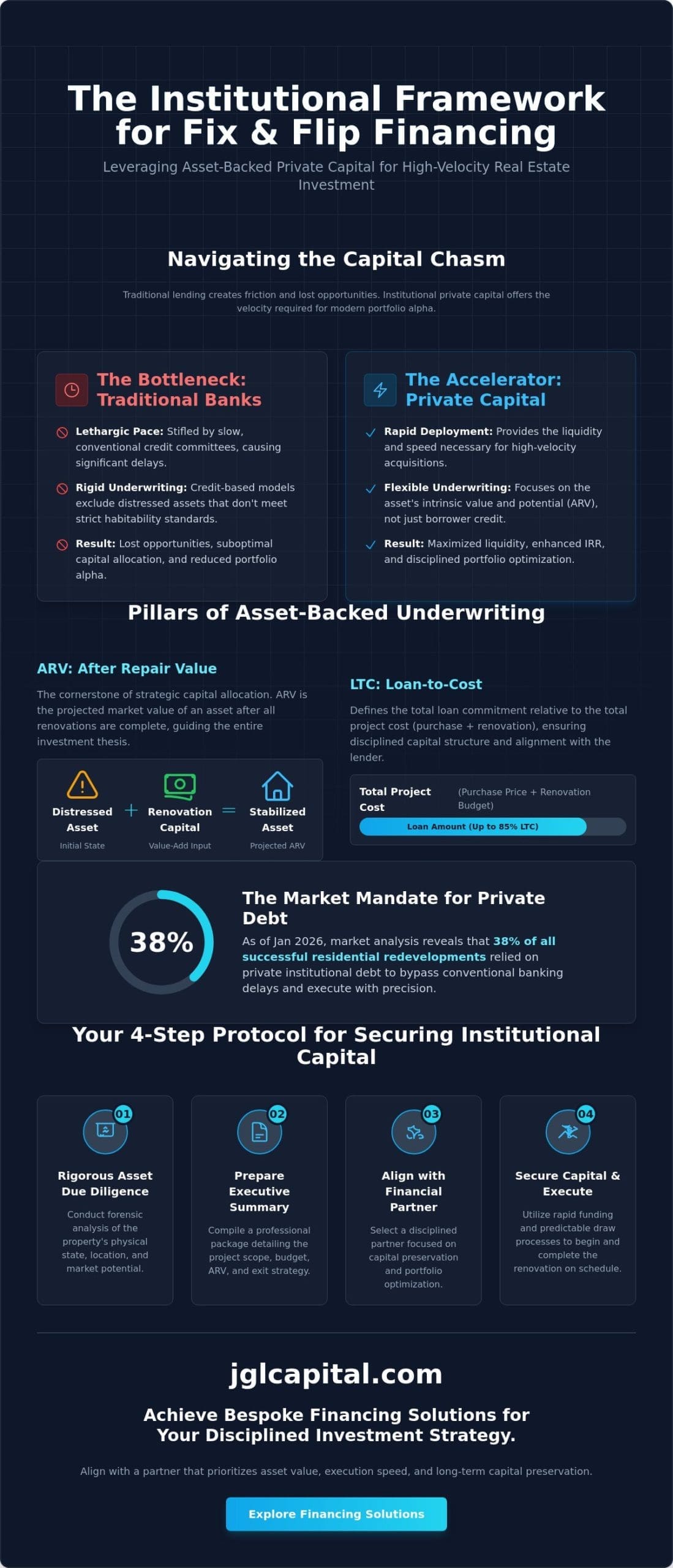
Traditional real estate loans are frequently hindered by rigid underwriting protocols that prioritize long-term stability over short-term strategic agility. These credit-based models often exclude properties that don’t meet strict habitability standards, such as those with structural defects or outdated systems. Fix and flip loans provide the necessary flexibility to secure these assets. Sophisticated investors don’t view the higher interest rates of private capital as a deterrent; instead, they frame it as a calculated cost of capital. This cost is a prerequisite for the speed required to execute on high-alpha opportunities. By January 2026, market analysis showed that 38% of successful residential redevelopments relied on private institutional debt to bypass the delays inherent in traditional banking. This disciplined approach to capital allocation ensures that investors can respond to market shifts without the constraints of conventional lending cycles.
The Mechanics of Asset-Backed Financing: How Fix and Flip Loans Operate
Fix and flip loans operate as sophisticated bridge instruments, designed to facilitate the seamless acquisition and subsequent revitalization of residential or commercial assets. These short-term vehicles generally possess a maturity window ranging from 6 to 18 months, a timeframe that necessitates a disciplined execution of the underlying renovation strategy. To support the borrower’s liquidity during the capital-intensive construction phase, these loans utilize an interest-only payment structure. This methodology ensures that debt service requirements don’t impede the deployment of resources toward value-enhancing improvements, thereby maintaining the project’s financial equilibrium until the final disposition or refinance occurs. By prioritizing cash flow preservation, these instruments allow sponsors to focus their analytical rigor on the physical transformation of the property.
The Role of ARV in Strategic Capital Allocation
Within the framework of institutional underwriting, the After Repair Value (ARV) functions as the cornerstone of the strategic capital allocation process. Lenders rely upon meticulous market analysis and forensic appraisal techniques to project the asset’s terminal value, considering both current macroeconomic conditions and hyper-local neighborhood trends. Because the renovation budget is intrinsically linked to the final valuation, any deviation in construction costs or material quality can significantly alter the risk-adjusted return profile of the investment. By establishing a conservative ARV based on comparable sales from the preceding 120 days, a disciplined steward of capital can ensure that the total loan commitment remains aligned with the long-term integrity of the portfolio. It’s through this lens of future valuation that lenders determine the maximum capital they’re willing to deploy.
Understanding LTC vs. LTV in 2026
Evaluating the complexities of leverage in 2026 requires a clear distinction between Loan-to-Cost (LTC) and Loan-to-Value (LTV) metrics. While LTV provides a ceiling for risk mitigation based on the projected exit price, LTC serves as the operational metric for funding the immediate requirements of the project. LTC is the ratio of the loan amount to the total cost of the project, including purchase and rehab. Most institutional frameworks limit LTV to a range between 65% and 75% of the ARV, a threshold that provides a necessary buffer against potential market contractions. Sophisticated investors frequently utilize fix and flip loans to achieve optimal capital efficiency, balancing the acquisition price with the requisite renovation capital to maximize equity multiples. This dual-metric approach ensures that the lender’s exposure is protected while providing the sponsor with the leverage necessary to execute high-conviction redevelopment projects.
Evaluating the Economic Logic: Private Capital vs. Institutional Banks
The primary objection to private capital often centers on the nominal interest rate, yet this narrow focus ignores the broader mechanics of capital velocity. Conventional institutional banks frequently require a 60-day window for underwriting and appraisal, a timeline that often proves fatal in a competitive 2026 real estate market. In contrast, private funding can facilitate capital deployment within 7 business days. This agility allows investors to secure distressed assets at a significant discount, often offsetting the higher cost of debt through immediate equity capture. Sophisticated investors view the lender as a strategic ally. This partnership provides oversight through rigorous property evaluation, ensuring the project aligns with disciplined risk-adjusted return profiles. Many private structures offer non-recourse or limited-recourse options, shielding the investor’s personal balance sheet from systemic shocks.
The Cost of Capital vs. The Cost of Lost Opportunity
Consider a scenario where a distressed asset is available for $1.2 million, roughly 22% below its intrinsic value, provided the buyer closes within 10 days. An institutional bank’s rigid 60-day process would result in a lost acquisition. While the fix and flip loans from private sources carry higher coupons, the ability to capture $264,000 in immediate equity far outweighs the incremental interest expense. Investors should also consider the tax efficiency of these structures. Interest payments on debt capital remain deductible, which effectively lowers the net cost of the loan. While the government offers programs like 203(k) Rehabilitation Mortgage Insurance for certain residential projects, these often lack the execution speed required for high-stakes institutional flipping. For those operating in specific markets, understanding hard money lenders in Florida provides a blueprint for how private capital can be allocated to capitalize on rapid market shifts.
Asset-Based Underwriting: Beyond the Credit Score
Private capital deployment relies on asset-based underwriting, a methodology that prioritizes the property’s projected profitability over the borrower’s personal debt-to-income ratio. This approach provides a layer of security for the investor. If the asset’s after-repair value (ARV) supports the loan-to-value requirements, the lender’s interests are perfectly aligned with the project’s success. This focus on the asset allows for superior portfolio optimization. It enables a single entity to manage five or six simultaneous fix and flip loans
Strategic Implementation: A Step-by-Step Guide to Securing Flip Financing
Executing a successful revitalization project requires more than architectural vision. It demands a disciplined approach to capital procurement. The lifecycle of fix and flip loans follows a structured trajectory that begins with rigorous asset selection.
Phase 1 involves exhaustive due diligence. Investors must scrutinize the property’s structural integrity and the surrounding submarket’s absorption rates. Following this, Phase 2 centers on crafting a comprehensive Executive Summary. This document serves as a high-level prospectus; it details the project’s risk-adjusted return potential and the sponsor’s track record.
In Phase 3, the lender initiates a third-party appraisal and feasibility study to validate the After Repair Value. This stage often determines the final loan-to-value ratio. Upon approval, Phase 4 marks the closing and the activation of a strategic draw schedule. Finally, Phase 5 concludes the cycle through a planned exit strategy. This is usually achieved through a market sale or a transition into long-term debt through refinancing.
Preparing Your Investment Pro Forma
A meticulous pro forma acts as the foundation of your funding request. Institutional lenders expect a comprehensive package that signals operational readiness. This package should include:
- A fully executed purchase contract detailing all terms and contingencies.
- A granular, line-itemized scope of work that accounts for 2026 material costs.
- Binding bids from licensed and insured general contractors.
Providing these documents upfront signals professional competence. It transforms a simple request into a sophisticated investment proposal. For those targeting specific high-growth corridors, reviewing Fix and Flip Loans in Florida: A Strategic Guide for Investors in 2026 provides necessary regional context for these calculations.
Managing the Renovation Draw Process
The draw schedule is the primary mechanism for capital deployment. It releases funds as specific construction milestones are achieved. Maintaining transparency with the lender’s inspector is vital. Delays often stem from poor documentation rather than construction failures.
Successful sponsors maintain sufficient liquidity to fund the initial stages of work before the first reimbursement. This ensures the project maintains its momentum. By aligning operational execution with financial oversight, investors preserve the integrity of their capital allocation strategy. Proper management of fix and flip loans ensures that interest carry costs don’t erode the project’s net margins.
Ready to optimize your next acquisition with a partner who understands institutional-grade capital? Secure your project funding with JGL Capital today.
JGL Capital: Bespoke Financing Solutions for Disciplined Investors
JGL Capital operates as a sophisticated steward of capital, providing institutional-grade support across a expansive national footprint. With over 30 years of strategic oversight experience, the firm remains committed to asset-based lending principles that prioritize the intrinsic value of real estate over the rigid, often arbitrary metrics utilized by retail banks. This institutional approach creates a fundamental alignment of interests, ensuring that JGL Capital only achieves its strategic objectives when the investor’s project reaches its full profit potential. This shared risk model transforms the lender-borrower dynamic into a high-level partnership designed for sustained growth.
Our team applies rigorous analytical standards to the evaluation of every opportunity, regardless of its complexity. JGL Capital possesses the specialized expertise required to manage diverse deal structures, including:
- Single-family residential fix and flip loans
- Multi-family value-add acquisitions and rehabilitations
- Ground-up residential and commercial developments
- Complex portfolio recapitalizations
The JGL Advantage: Precision and Professionalism
By eliminating the traditional banking bureaucracy that often stifles opportunistic acquisitions, JGL Capital provides a streamlined underwriting process that prioritizes speed without compromising analytical rigor. This efficiency allows for rapid execution in competitive markets where timing is the primary driver of value. As your portfolio scales, the ability to access diverse financing vehicles becomes a critical component of your capital stack. Having a partner who provides New Construction Loans alongside sophisticated Commercial Real Estate Loans ensures your growth is never constrained by capital limitations. We prioritize the construction of lasting legacies, focusing on the strategic expansion of wealth through disciplined, professional interactions rather than fleeting, transactional relationships.
Securing Your Next Capital Allocation
The path to securing capital begins with a strategic alignment session, a process designed as a rigorous assessment of both project viability and the long-term objectives of the investor. We don’t view these as mere intake calls; they’re fundamental components of a collaborative investment strategy where we evaluate risk-adjusted returns together. JGL Capital maintains a steadfast commitment to delivering fast, reliable funding for fix and flip loans and other vetted opportunities. This reliability is vital for investors who require certainty of execution to secure high-value assets. You can Partner with JGL Capital for your next fix and flip project to experience a level of professionalism that matches the gravity of your financial goals. We stand ready to provide the sophisticated capital necessary for your next high-stakes real estate allocation.
Mastering Capital Deployment for the 2026 Property Cycle
The real estate environment in 2026 necessitates a shift toward sophisticated capital allocation strategies that prioritize asset quality over traditional borrower profiles. Success in this cycle depends on the ability to secure financing that mirrors the analytical rigor of institutional management while retaining the flexibility of private capital. By utilizing fix and flip loans, disciplined investors can achieve superior risk-adjusted returns through precise project execution and strategic oversight. JGL Capital facilitates this growth by applying over 30 years of industrial expertise to every transaction we evaluate. Our asset-based underwriting framework focuses on the projected ROI of the specific project, ensuring that capital is deployed where it’s most productive regardless of personal credit fluctuations. With a national reach and a commitment to bespoke solutions, we serve as a discreet steward of your investment vision. It’s a partnership built on the timeless principles of finance and the pursuit of lasting value creation. Your next acquisition deserves the stability of a seasoned strategic ally.
Secure Strategic Capital for Your Next Deal with JGL Capital
Frequently Asked Questions
What is the minimum credit score required for a fix and flip loan?
Institutional lenders typically require a minimum FICO score of 660 to ensure the alignment of interests between the capital provider and the sponsor. While some private debt funds might consider scores as low as 620 for experienced operators, maintaining a profile above 720 often facilitates the optimization of interest rates and leverage ratios. This threshold serves as a critical metric in our disciplined approach to risk-adjusted returns and portfolio stability.
How much down payment is typically required for a fix and flip project?
Investors should anticipate a down payment ranging from 15% to 25% of the asset’s purchase price, depending on the sponsor’s track record and the project’s specific risk profile. In the current 2026 fiscal environment, most bridge financing structures require at least a 15% equity contribution to maintain prudent capital allocation. This capital infusion ensures that the borrower retains a tangible stake in the successful execution of the renovation strategy and long-term value creation.
Can I get a fix and flip loan with no previous experience?
Capital is available for nascent investors, though these individuals often face more stringent leverage constraints, such as a 70% Loan-to-Cost limit. Established firms prioritize stewardship and typically favor sponsors with 3 or more successful exits within the preceding 24 months. For those without a documented history, partnering with an experienced general contractor can mitigate perceived operational risks and improve the terms of fix and flip loans during the underwriting process.
What property types are eligible for fix and flip financing?
Eligible assets primarily include single-family residences, 2 to 4 unit multi-family properties, and occasionally mixed-use buildings with a residential component exceeding 51%. Commercial structures or large-scale apartment complexes generally require specialized bridge debt rather than standard residential renovation facilities. Every property must undergo a rigorous valuation process to determine its After Repair Value, ensuring the project aligns with the firm’s strategic objectives and capital preservation mandates.
How do interest-only payments work during the renovation phase?
During the renovation phase, borrowers make monthly payments based solely on the interest accrued on the outstanding principal balance. This structure preserves liquidity for operational expenses, as the principal isn’t amortized over the life of the loan. Since interest is often calculated only on drawn funds, the sponsor’s debt service remains proportional to the capital deployed at each stage of the construction timeline, allowing for more efficient cash flow management.
What happens if the renovation takes longer than the loan term?
If a project exceeds its initial 12 or 18 month term, sponsors must typically negotiate a formal loan extension or face default penalties. Most institutional lenders offer 3 to 6 month extensions in exchange for an additional fee, often 1% of the loan amount, provided the project shows measurable progress. Proactive communication is essential to maintain the partnership’s integrity and avoid the adverse effects of a matured debt obligation on the sponsor’s credit profile.
Are fix and flip loans available for new construction projects?
Fix and flip loans are frequently structured to accommodate new construction projects, which the industry often classifies as ground-up development. These facilities provide the necessary capital for land acquisition and vertical construction, though they require a more detailed feasibility study and a 10% to 15% contingency budget. Such projects demand a high level of strategic oversight to manage the extended timelines and complex permitting processes inherent in modern urban development.
How quickly can a fix and flip loan be funded?
Funding for these instruments can be finalized in as few as 7 to 14 business days, which is significantly faster than the 45 day window required for conventional mortgages. This expedited timeline allows investors to secure distressed assets in competitive markets where speed of execution is a primary advantage. By utilizing a streamlined due diligence process, the firm ensures that capital is deployed with the precision and urgency that high-stakes real estate transactions demand.