

What if the financing path for a retail renovation depends as much on the exit plan as on the work itself? A retail space renovation loan may be considered alongside bridge financing or broader commercial real-estate financing. The right fit depends on how the property, renovation scope, timeline, and repayment strategy align. It can be challenging to bring those pieces together before a lender reviews the request.
This guide covers key financing considerations for a business-purpose retail renovation, the project details and supporting materials that help present a clear request, and how to compare proposals by their full structure, requirements, and exit flexibility. JGL Capital LLC is a private-money broker and capital advisor, not a lender. JGL Capital helps organize financing requests, identify prospective private and institutional capital sources, compare potential structures, and coordinate communication. Each lender independently underwrites requests and determines approval, terms, proceeds, and timing.
Key Takeaways
- Separate acquisition, renovation, tenant improvement, stabilization, and refinance needs so the financing request reflects the project’s purpose.
- Present the property’s condition alongside sponsor experience, liquidity, reserves, credit, and guarantor information. Property value alone doesn’t tell the full story.
- Compare proposals across total costs, recourse, reserves, conditions, and extension provisions, rather than relying on a headline rate or term.
- Build a concise retail space renovation loan package covering the transaction, requested proceeds, work scope, timeline, and repayment plan. JGL Capital is a private-money broker, not a lender. Lenders make their own underwriting and approval decisions.
Retail Space Renovation Loan: Define the Project Before Comparing Financing
A retail renovation request seeks business-purpose financing for an eligible commercial property and a defined transaction. It is not a guaranteed loan offer. A commercial property may include retail space, but the asset type alone doesn’t determine whether a lender will consider the project or what structure it may offer. JGL Capital LLC is a private-money broker and capital advisor, not a lender. Lenders set their own requirements and make independent underwriting and approval decisions.
Start by identifying the project’s objectives. Is capital needed to acquire the property, rehabilitate it, complete tenant improvements, stabilize operations, or refinance after the work? These needs can overlap, but they relate to different stages and repayment plans. Define each one so the request reflects the transaction rather than treating “renovation” as a single, universal loan category.
Which retail renovation costs and objectives belong in the project scope?
Group planned work into essential repairs, tenant improvements, building systems, and broader repositioning. For each category, explain how it relates to the property’s current condition and business plan. For example, a systems upgrade might address a documented building need, while tenant improvements might prepare space for its intended use. Connect each cost to a specific part of the plan, and don’t assume every improvement or property type fits every lender’s criteria.
When might bridge or commercial real-estate financing be considered?
Bridge financing may fit an eligible transition or rehabilitation scenario, particularly when the plan is to complete work before pursuing longer-term financing. Commercial real-estate financing is a broader category. The appropriate structure depends on the transaction, property, project scope, and exit plan. JGL Capital helps package the request and identify prospective capital sources, while lenders determine the terms they may offer. For broader context, see Commercial Real Estate Loans: A Strategic Guide to Capital Allocation in 2026.
How Lenders Assess Retail Renovation Financing, and Why Property Value Is Not Enough
Property value is one part of a lender’s review, not a complete measure of project readiness. Lenders may also assess the property’s condition, purchase basis, title, insurance, and supporting documents, along with the sponsor’s experience, liquidity, reserves, credit, and guarantor information. A retail space renovation loan request is easier to evaluate when those details align with a defined scope, supported budget, workable timeline, and clear business-purpose rationale.
Feasibility matters. The proposed renovation should make sense in light of the property’s current condition and the borrower’s plan for the asset. Each prospective lender sets its own requirements and evaluates the property, sponsor, project, and repayment strategy independently. It helps organize project information and identify prospective capital sources, but lenders make underwriting and approval decisions.
What does a credible renovation budget need to communicate?
Organize costs by work category, with supporting estimates, anticipated timing, and clearly stated contingency assumptions. Connect each cost to the proposed scope so a reviewer can see what remains to be done and how the work relates to the property. Lender requirements and draw procedures differ. Unsupported scope or missing costs are planning gaps to address, not automatic disqualifiers. Forbes’ consumer-focused Best Home Improvement Loans guide offers a general comparison reference, though retail property financing involves distinct commercial considerations.
How should the exit strategy shape the request?
Describe a plausible repayment path, such as refinancing, selling, stabilizing the property, or another documented plan. Then consider what could happen if work takes longer than expected or costs exceed the current budget. Explain how those changes might affect repayment and what alternatives you could pursue. An exit plan supports lender review, but it doesn’t guarantee approval or a particular outcome.
JGL Capital helps organize project packages and compare prospective lender structures. Discuss your retail renovation financing request with JGL Capital.
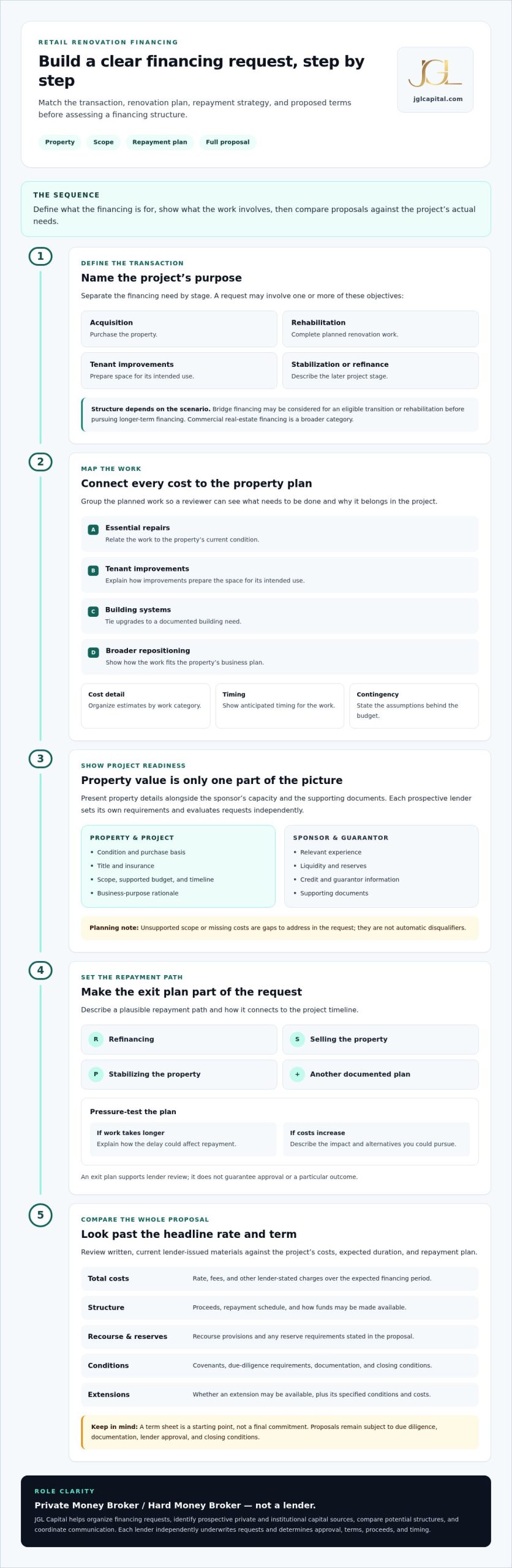
Compare Retail Renovation Loan Proposals by Structure, Conditions, and Exit
Assess a retail space renovation loan proposal as a complete financing arrangement, not by its headline rate or stated term alone. Compare written terms against the project’s costs, expected duration, and repayment plan. Use current lender-issued materials to review fees and terms. Don’t treat illustrative figures as though they apply to your transaction.
| Proposal item | What to compare |
|---|---|
| Total costs | Rate, fees, and other lender-stated charges over the expected financing period. |
| Structure | Proceeds, repayment schedule, and how funds may be made available. |
| Recourse and reserves | Recourse provisions and any reserve requirements stated in the proposal. |
| Conditions | Covenants, due-diligence requirements, documentation, and closing conditions. |
| Extensions | Whether an extension may be available, and the conditions and costs specified. |
Which financing terms deserve careful comparison?
A term sheet is a starting point, not a final commitment. Proposals remain subject to due diligence, documentation, lender approval, and closing conditions. Compare each structure against the same project assumptions. A different repayment structure or reserve requirement can change the overall fit, so don’t assume one option is universally cheaper, faster, safer, or easier to obtain. The SBA’s SBA 504 Loans page describes a separate financing program. Its terms and eligibility shouldn’t be assumed to apply to a private or other commercial proposal.
How can borrowers assess cost against project duration and exit?
Compare the expected financing period with a realistic schedule for renovation, lease-up, sale, or refinance. Consider how delays could affect carrying costs, extension needs, and the planned exit. These assumptions help frame the comparison, but they aren’t guaranteed outcomes. For additional context on transitional financing, see What Is a Bridge Loan? A Strategic Guide to Transitional Real Estate Capital.
JGL Capital helps borrowers organize project information and compare prospective lender structures. Each lender sets its own terms and makes its own decisions. Discuss your retail renovation project with JGL Capital LLC.
Prepare a Retail Renovation Financing Request and Choose the Next Step
A well-organized request helps prospective capital sources understand the transaction before reviewing its details. Use this readiness sequence to gather the essentials:
- Transaction: State whether you’re acquiring, renovating, stabilizing, or refinancing the property.
- Capital: Specify the proceeds requested and how you expect to use them.
- Collateral: Identify the property, asset type, current condition, and relevant ownership or transaction details.
- Sponsor: Summarize relevant experience, available liquidity, and capital already invested.
- Timing: Set out the renovation schedule, key deadlines, and any expected lease-up or sale period.
- Exit: Describe the planned repayment path and the assumptions behind it.
What should a concise retail renovation deal summary include?
Keep the summary direct. Include the property address, asset type, transaction status, requested amount, and intended use of proceeds. Then outline the property’s condition, renovation scope, budget support, sponsor background, available liquidity, business plan, timeline, and exit assumptions. Attach relevant supporting documents where available. A clear package distinguishes a defined retail space renovation loan request from an early-stage idea, without suggesting that financing is assured.
What happens during an initial financing-fit review?
JGL Capital clarifies the property, borrower, requested proceeds, deadline, relevant experience, capital invested, and repayment plan. As a private-money broker and capital advisor, not a direct lender, JGL Capital helps package project information and identify prospective private and institutional capital sources. Supporting-document requirements vary by lender, program, property, and transaction. Lenders conduct their own underwriting and determine approval, terms, proceeds, and closing conditions.
If the project is ready for an initial discussion, submit a retail renovation project for an initial financing-fit review. The review can help frame the request, but it doesn’t guarantee lender interest, approval, or financing.
Bring the Renovation Plan and Financing Strategy Into Alignment
A well-prepared retail renovation request connects the property’s condition and improvement scope to a credible timeline and repayment plan. Property value alone doesn’t determine the right financing path. Compare proposals across their full structure, conditions, costs, and exit flexibility.
Before moving forward, bring the transaction details, budget support, sponsor information, and repayment assumptions into one clear package. JGL Capital helps organize financing requests and identify prospective private and institutional capital sources. Each lender independently evaluates the project and decides whether to approve financing and on what terms.
Ready to discuss how your project may be presented for review? Submit your retail renovation project for an initial financing-fit review. A clear, well-aligned request is a practical next step toward evaluating your options.
Frequently Asked Questions
Is a retail space renovation loan the same as a commercial real estate loan?
Not necessarily. A retail renovation request may be considered under commercial real-estate or bridge-financing options, depending on the property, transaction, scope, borrower, and prospective lender. Those terms don’t establish that a particular option is available. JGL Capital helps identify prospective capital sources, while selected lenders determine program fit, requirements, and final approval.
Can I use renovation financing for a retail property I own?
Possibly, for a business-purpose renovation of an eligible commercial property, but ownership alone doesn’t establish eligibility. Lenders may review the property, proposed work, borrower qualifications, supporting documents, reserves, and exit plan. Requirements differ by lender and transaction. JGL Capital doesn’t arrange owner-occupied residential mortgage financing, and each lender independently decides whether to consider and approve a request.
What do lenders evaluate for retail renovation financing?
Lenders may review property value and condition, purchase basis, title, insurance, renovation scope and budget, sponsor experience, liquidity, credit, documentation, and the repayment or exit strategy. The factors they emphasize can vary by lender and transaction. Collateral matters, but it doesn’t determine approval by itself or guarantee proceeds, terms, or a closing date. The request should connect the property’s condition and proposed work to a credible business-purpose plan.
How should I compare retail renovation loan offers?
Compare the complete structure, not just the headline rate. Review proposed proceeds, fees, repayment terms, recourse, reserves, covenants, draw procedures, extension rights, and closing conditions. Then assess whether the timing fits the renovation and planned exit. A term sheet doesn’t guarantee funding. Final terms remain subject to lender underwriting, due diligence, documentation, and approval, so use current lender-issued materials to compare proposals.
What information should I prepare before discussing a retail renovation loan?
Prepare a concise summary covering the property and transaction status, requested proceeds, use of funds, current condition, renovation scope, budget support, sponsor experience, available liquidity, target timeline, and exit strategy. Supporting records vary by lender and transaction. JGL Capital, a private-money broker and capital advisor, helps organize and present requests to prospective lenders. The lender determines approval and terms; no outcome is promised.