

The lot can be right for a custom home and still put pressure on the project if its financing doesn’t fit the build budget and exit. That’s the central challenge with lot loans for custom home builders: land acquisition and construction are connected, but lenders may assess and structure them separately.
It’s reasonable to want a clear view of the capital required, the project timeline, and the documentation a lender may expect before committing to a parcel. This guide explains how lot financing differs from construction financing, when the two may be arranged separately or considered together, and what lenders may evaluate, from the parcel and project plan to borrower capacity and exit strategy.
JGL Capital LLC is a private money broker and capital advisor, not a lender. We help organize business-purpose real estate requests and identify prospective capital sources; lender decisions and final terms remain with the selected lender. The aim is to help you prepare a credible project summary and have a more informed financing discussion before the land purchase sets the project in motion.
Key Takeaways
- For lot loans for custom home builders, clarify the project’s business purpose and how the parcel supports the planned build.
- Prepare parcel details that help explain access, utilities, site conditions, and overall build feasibility for lender review.
- Organize purchase documents, project costs, timing, sponsor background, available capital, and a credible exit into a clear request.
- Compare lot-only, coordinated, and staged financing as possible structures; a private money broker can help present the request to prospective capital sources, while lender decisions and terms remain theirs.
Lot Loans for Custom Home Builders: Start With the Parcel and Project Purpose
For custom home builders, a parcel can’t be assessed in isolation from the plan for using it. A useful financing discussion connects the land’s status and intended use with the scope of the build, the project budget, and the anticipated source of repayment. Whether the lot is improved or requires further work may shape how a prospective lender views the request, alongside the borrower’s capacity and supporting documentation.
Lot financing is potential business-purpose capital for acquiring eligible land, subject to the selected lender’s requirements. It does not, by itself, guarantee that construction financing will be available. The Self-build process can take different forms, but for a business-purpose project, the financing request should make clear what will be built, how the parcel supports that plan, and how the project is expected to repay its obligations.
Does lot financing include the cost of building?
Not necessarily. Land acquisition and construction may be financed separately, or considered through a coordinated structure; staged financing may also be part of the discussion. Which structure is available, and which project costs may be eligible, depends on the transaction and the selected lender. Lot financing alone shouldn’t be treated as confirmation that funds for construction will follow.
Business-purpose project or owner-occupied home?
The purpose of the transaction matters. JGL CAPITAL is a private money broker and capital advisor focused on business-purpose real estate transactions, not owner-occupied residential mortgages. A custom-home project presented for investment or development is different from financing a personal residence. JGL CAPITAL helps organize financing requests and identify prospective capital sources; underwriting, approval, and final terms remain subject to the selected lender.
How Lenders May Evaluate a Lot Loan for a Custom Build
A parcel’s appeal is only one part of a financing request. Lenders may consider its value and condition, the purchase terms, and whether zoning, access, utilities, and site conditions support the proposed build. They may also review the borrower’s relevant experience, liquidity, and documentation. Lenders may assess the borrower, collateral, project feasibility, and exit together.
For lot loans for custom home builders, the construction plan should make the land’s intended role clear. Include a credible preliminary budget and schedule, with a construction draw schedule if available, so the prospective lender can understand how the project is expected to progress. The Consumer Financial Protection Bureau explains the basic concept of a construction loan, which can help distinguish building funds from land-acquisition financing.
What project details help explain the parcel?
Provide the parcel address, purchase terms, current status, intended use, and available property information. Then connect those facts to the proposed home: planned specifications, build scope, preliminary budget, and anticipated schedule. Clear details help frame questions about feasibility; they don’t establish eligibility or guarantee financing.
Why the exit strategy matters before acquisition
Set out how the project is expected to repay its obligations, such as through a sale or a later financing arrangement, without assuming that either path will be available. Test the plan against schedule changes, higher costs, and a delayed exit. That exercise can reveal whether the proposed capital plan remains workable if the build takes longer than intended.
JGL CAPITAL is a private money broker and capital advisor, not a lender. We help organize business-purpose financing requests and identify prospective capital sources; underwriting decisions and final terms remain with the selected lender. A custom-home project financing discussion can begin with a clear view of the parcel, build plan, and repayment strategy.
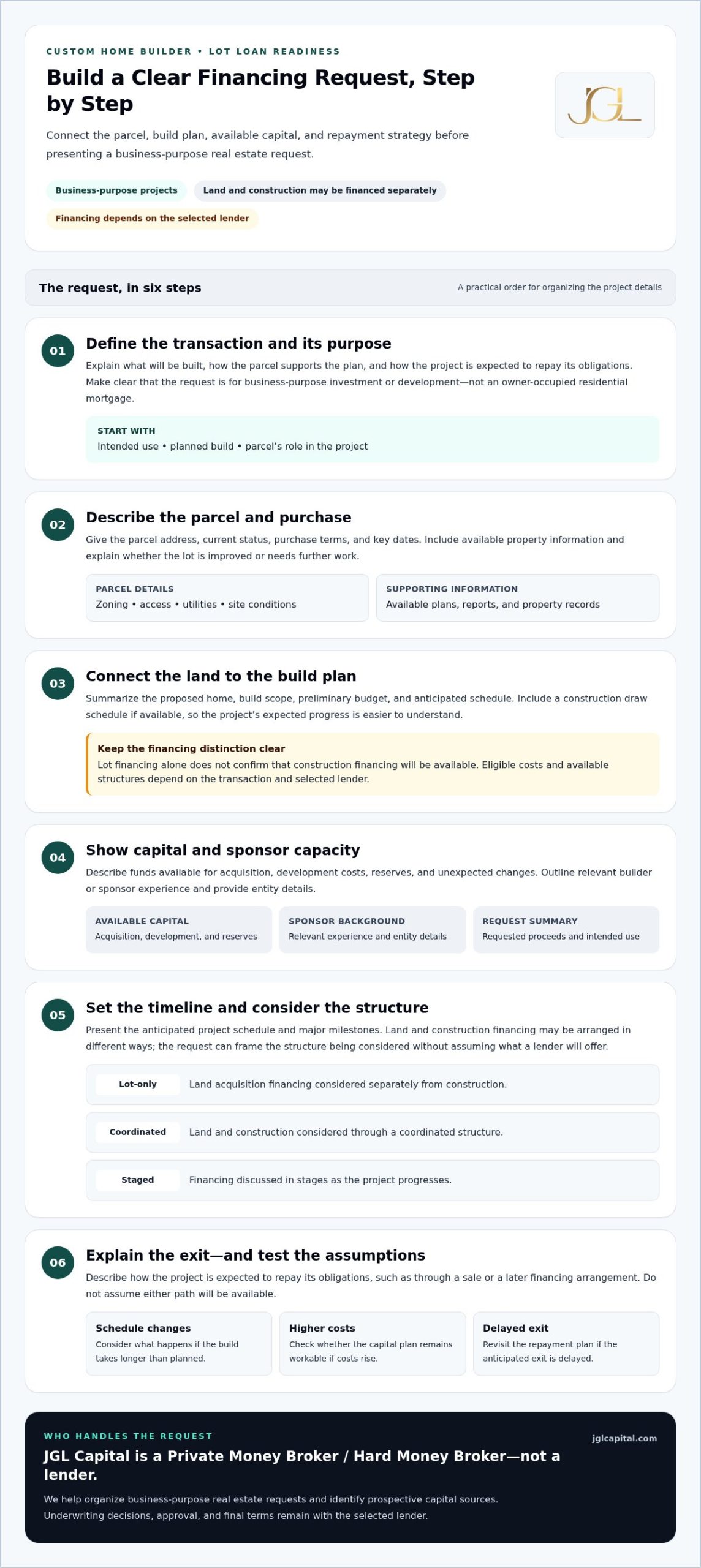
Custom Home Builder Lot Loan Readiness Checklist
A well-prepared request makes it easier to understand how the parcel, build plan, and repayment strategy fit together. For lot loans for custom home builders, organize the information in a consistent order and identify requested proceeds and their intended use without assuming a particular loan amount or structure.
- Transaction: Summarize the purchase terms, current status, and key dates.
- Capital: Describe funds available for acquisition, development costs, reserves, and unexpected changes.
- Collateral: Provide parcel details, site information, and available plans or reports.
- Sponsor: Outline the builder or sponsor’s relevant experience and entity details.
- Timing: Present the anticipated project schedule and major milestones.
- Exit: Explain the repayment plan and what may change if the timeline shifts.
Documents and information to organize
Prepare a concise deal summary covering the parcel, purchase terms, project scope, requested financing, and timeline. Add available plans, preliminary budget materials, site information, entity details, and relevant sponsor experience. For construction-financing context, see New Construction Loans: A Strategic Guide for Real Estate Developers (2026), along with the Associated General Contractors of America’s construction financing process guide.
Questions to resolve before presenting the request
Account for the capital available across acquisition, development, reserves, and potential cost changes. Identify the assumptions behind the repayment plan, then consider a credible alternative if completion or sale is delayed. A clear package helps a broker present the project to prospective capital sources; it doesn’t determine a lender’s decision or terms.
JGL CAPITAL is a private money broker and capital advisor, not a lender. To discuss a project for an initial financing-fit review, bring the parcel details, available project materials, and current capital plan. Any financing remains subject to the selected lender’s requirements and final approval.
Explore Lot and Construction Financing Options With a Private Money Broker
There isn’t one structure that fits every custom build. A request may involve lot-only financing, a coordinated arrangement that considers land and construction together, or staged financing in which land acquisition and the build are addressed at different points. These are possibilities, not guaranteed programs. The right discussion starts with the project’s purpose, parcel, budget, timeline, and repayment plan.
JGL Capital LLC is a private money broker and capital advisor, not a lender. For lot loans for custom home builders, we help organize financing requests, identify prospective private and institutional capital sources, compare possible structures, and coordinate communication. Each selected lender independently determines its underwriting, documentation requirements, approval decision, terms, proceeds, and timing. Broker support does not guarantee approval, funding, improved terms, or a particular closing date.
What a private money broker does in the process
The process may begin with an initial fit review of the business-purpose project, followed by deal packaging and lender-source identification. Comparing possible structures can help clarify how the land request relates to the planned construction and exit. A broker can support the presentation and communication, while the lender retains all decision-making authority. For related educational context, see the Private Money Lenders guide; it should not be read as a statement about geographic service availability.
A practical next step for builders
Prepare a concise summary covering the parcel, purchase terms, build scope, preliminary budget, available capital, schedule, sponsor background, and intended repayment path. Related reading on the New Construction Loans guide can help frame the construction portion of the request. Company background is available through the JGL Capital About page.
If you’re ready to discuss a business-purpose custom-home project and potential capital sources, discuss your custom home project. Any financing remains subject to the selected lender’s requirements and final approval.
Bring the Lot and Build Plan Into One Clear Request
A sound financing discussion starts with more than the parcel: it connects the land’s status and intended use to the construction budget, schedule, available capital, and a credible repayment plan. Lot loans for custom home builders may be structured separately from construction financing or considered as part of a coordinated approach, but the fit depends on the project and the selected lender’s requirements.
JGL CAPITAL is a private money broker and capital advisor, not a direct lender. We review the project, help package the financing request, identify potential lender sources, and coordinate communication. Each lender independently determines its underwriting, approval, terms, proceeds, and timing, so no outcome is assured.
If you’ve assembled the core parcel and project details, discuss your custom home project with JGL CAPITAL. A clear, well-supported request is a practical next step toward exploring potential capital sources with discipline and confidence.
Frequently Asked Questions
Can custom home builders use lot loans to buy land?
Potentially, when the purchase is part of an eligible business-purpose transaction. For lot loans for custom home builders, the selected lender may consider the parcel, intended use, borrower qualifications, project feasibility, and supporting documentation. Land financing doesn’t guarantee approval or a separate construction facility. JGL CAPITAL is a private money broker and capital advisor, not a direct lender, and doesn’t arrange owner-occupied residential mortgages.
What do lenders look at for a lot loan?
Lenders may review the parcel’s value and condition, purchase terms, intended use, borrower experience, available liquidity, project budget, documentation, and repayment plan. The specific review depends on the lender and transaction. The property alone doesn’t determine approval. A broker can help organize and present the request, but can’t guarantee proceeds, leverage, terms, or a closing date.
Can a lot loan include construction costs?
Some financing structures may coordinate land acquisition and construction, while others address them separately. The available approach depends on the project and the selected lender’s program, documentation requirements, underwriting, and draw procedures. Present the parcel, build scope, budget, anticipated schedule, and repayment plan together so prospective lenders can assess how the land purchase relates to the full project.
How is a lot loan different from a construction loan?
A lot loan generally concerns acquiring or financing land. Construction financing addresses eligible building costs and may involve funds released according to a draw schedule. The two needs can be structured separately or considered together, depending on the project and lender requirements. Neither financing type guarantees approval, so understand the expected repayment path for each stage before proceeding with the transaction.
Does a term sheet guarantee funding for a custom build?
No. A term sheet summarizes proposed financing terms; it doesn’t guarantee that funding will occur. The selected lender may still require underwriting, due diligence, documentation, approvals, and satisfaction of closing conditions, and retains control of final decisions. JGL CAPITAL can help package a request and coordinate communication as a private money broker, but it doesn’t approve or fund transactions or guarantee proposed terms.