

What if asking for more financing made a real-estate deal harder to support? It’s understandable to focus on the requested amount, especially when limited liquidity or incomplete documentation already feels like a constraint. But how to increase borrowing capacity for real estate is less about pursuing maximum leverage and more about presenting a borrower, property, and transaction that a prospective lender can evaluate clearly.
Borrowing capacity may depend on the borrower’s financial profile, the property’s income and condition, the requested structure, and the repayment or exit plan. Improving one part of the request can help, but the pieces need to fit together. A coherent project plan and organized supporting documents make the transaction’s strengths and gaps easier to assess.
This article explains what lenders may evaluate, practical ways to strengthen a financing request, and how to compare bridge, rental-property, and DSCR financing against a project’s needs and risks. JGL Capital LLC is a private money broker and capital advisor, not a lender. The firm helps organize business-purpose real-estate financing requests and identify potential capital sources; each lender makes its own decisions and sets its own requirements and terms.
Key Takeaways
- Borrowing capacity is a lender-specific assessment shaped by the borrower, property, liquidity, documentation, and exit plan. Collateral alone does not establish a guaranteed maximum.
- To understand how to increase borrowing capacity for real estate, organize borrower and property information so prospective lenders can assess the complete transaction.
- Prepare a concise deal summary explaining the property, requested proceeds, use of funds, condition, timeline, and credible exit.
- Compare bridge, construction, DSCR, and other financing paths by purpose, requirements, costs, and fit. JGL CAPITAL is a private money broker, not a lender.
What Determines Real Estate Borrowing Capacity?
Borrowing capacity is the amount and structure a prospective lender may consider for a specific real-estate transaction after evaluating the borrower, property, and repayment plan. It is not a guaranteed maximum. The requested proceeds begin the discussion; the lender’s underwriting determines what it may offer, if anything, and on what terms.
Collateral matters, but it is only one part of the assessment. A lender may also review borrower qualifications, available liquidity, relevant experience, supporting documents, the business plan, and the proposed exit. Personal obligations may matter for some financing assessments. The Debt-to-income ratio describes one way of comparing debt payments with income, although its relevance and application depend on the lender and transaction. JGL CAPITAL LLC is a private money broker and capital advisor, not a lender. Prospective lenders set their own criteria and make their own decisions.
Why property value alone does not determine capacity
A valuation is one input, not the whole case. Purchase basis, property condition, current or projected income, and the feasibility of planned work can all affect how a lender views the collateral and request. For example, a property requiring substantial improvements needs a clear scope, credible budget, and workable timeline, not just a value estimate. Lenders may weigh each factor differently.
Capacity, leverage, and project feasibility
Loan-to-value (LTV) compares the proposed loan with a property’s value. Loan-to-cost (LTC) compares it with defined project costs. Lenders may use different definitions of eligible costs and different valuation bases, so neither measure sets a universal borrowing limit.
A supportable request should fit the project’s budget and timeline, with a credible path to repayment or exit. This is central to how to increase borrowing capacity for real estate: show how the proposed structure addresses the project’s actual needs without relying on maximum leverage alone. If the proceeds, execution plan, and exit do not align, the request may be difficult to assess even when the property appears valuable.
How to Strengthen the Borrower and Property Profile
A clear financing request helps prospective lenders understand who is sponsoring the project, what the property needs, and how the plan is expected to work. Asset-based financing still involves more than collateral. Depending on the lender and transaction, credit history, relevant experience, available liquidity, and the ability to manage project obligations may also matter.
Lenders may consider the sponsor’s qualifications, available capital, property condition and income, project feasibility, supporting documents, and proposed exit. Criteria vary by financing source. Organized financial, entity, and property information helps present these factors consistently. It does not replace underwriting or remove a lender’s documentation requirements.
Present a credible sponsor profile
Summarize relevant real-estate experience and explain the sponsor’s role in executing the plan. Organize financial records and entity information, and provide a clear picture of available capital and liquidity. If experience is limited, be candid and explain how responsibilities will be handled. Requirements differ by lender and transaction. A complete, accurate package is more useful than assuming asset-based financing makes borrower qualifications irrelevant.
Make the collateral and project easier to evaluate
Bring property details, purchase information, current condition, income information, and planned use of proceeds into one consistent account. A realistic budget should connect the property’s needs to the requested funds. For construction or renovation, outline the scope of work, budget, schedule, and contingency assumptions. Gaps between these elements can make project feasibility harder to assess.
This preparation is a practical part of how to increase borrowing capacity for real estate: it helps a prospective lender evaluate the whole request, but cannot guarantee a particular decision or amount. Business-purpose borrowers can share a concise project overview for an initial financing-fit review through JGL CAPITAL’s real-estate financing guidance.
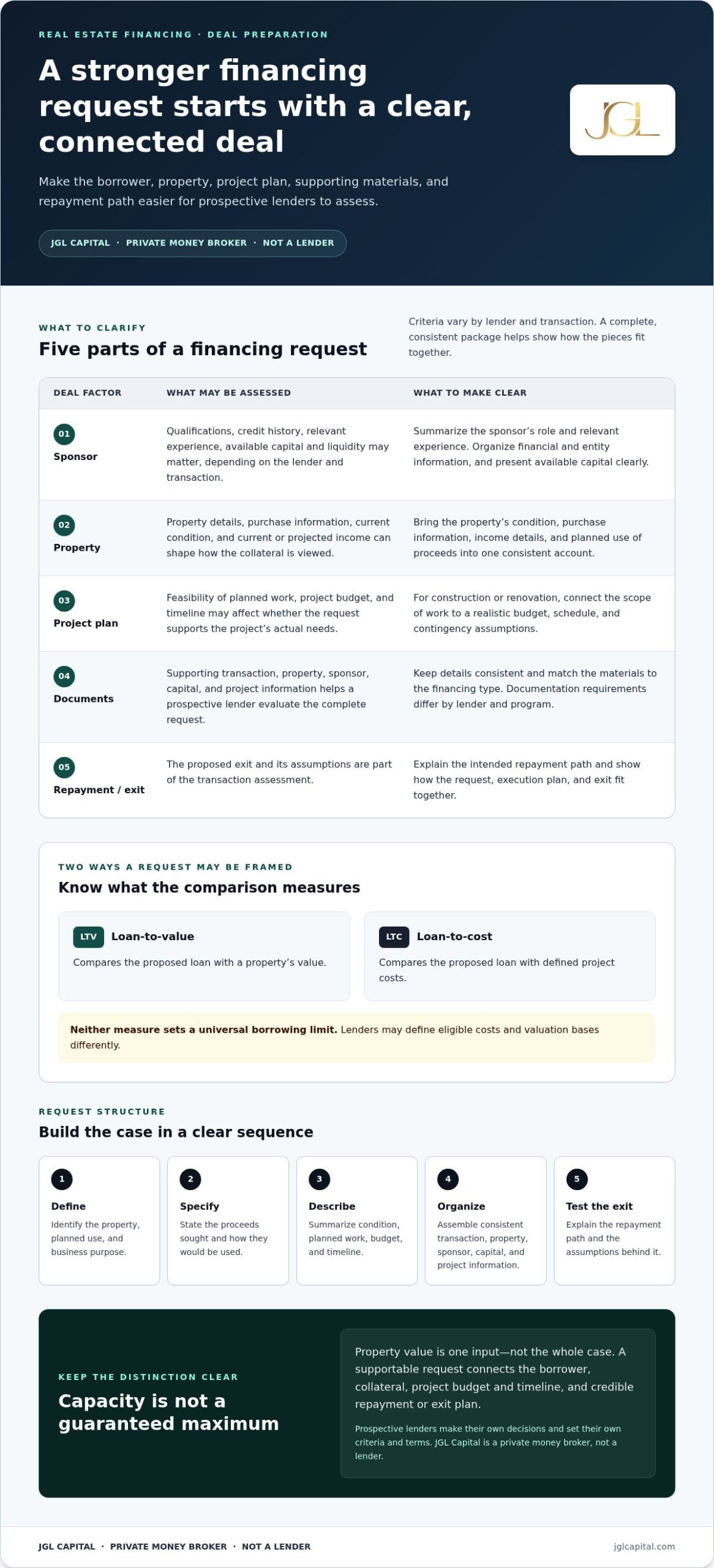
How to Prepare a Stronger Real Estate Financing Request
A well-prepared request gives prospective lenders a clear view of the transaction, the capital required, and the repayment plan. Assemble the key points before presenting the deal:
- 1. Define the transaction. Identify the property, explain what you plan to do with it, and state the business purpose of the financing.
- 2. Specify the request. State the proceeds sought and how they would be used. Connect the amount to the project’s needs instead of presenting it without context.
- 3. Describe the collateral and execution plan. Summarize the property’s condition, planned work, budget, and timeline. For development, make sure the budget and schedule support the scope. JGL CAPITAL’s new construction financing guide can help frame relevant considerations.
- 4. Organize supporting materials. Assemble transaction, property, sponsor, capital, and project information in a consistent package. Match the materials to the financing type because requirements differ by lender and program.
- 5. Test the exit. Explain the intended repayment path and the assumptions behind it. Consider what could change if the project takes longer than planned, including carrying costs, available reserves, and contingencies.
Build a complete, coherent deal package
Prepare a concise deal summary covering the property, requested proceeds, use of funds, current condition, timeline, and exit. Supporting documents should substantiate the summary. If the budget, timeline, or property details differ across materials, reconcile them before submission. Consistent information protects credibility and helps prospective lenders assess the request without having to piece together competing versions of the plan.
This discipline is a practical part of how to increase borrowing capacity for real estate, although it cannot dictate a lender’s decision. JGL CAPITAL is a private money broker and capital advisor, not a lender. Submit a concise deal summary to discuss an initial financing-fit review for a business-purpose transaction.
Compare Financing Paths and Choose a Practical Next Step
A suitable financing structure fits the transaction, not necessarily the lowest quoted rate or the largest possible proceeds. Compare purpose, timeline, collateral, documentation, liquidity needs, costs, and exit together. Bridge, construction, DSCR, and other real-estate financing programs serve different purposes. Prospective lenders set requirements according to their own criteria.
Match the financing approach to the transaction
For a transitional project, consider whether bridge financing aligns with the work timeline and repayment plan. For a rental property, income and operating information may be central to the request. A development project instead calls for a clear construction scope, budget, schedule, and any draw-related documents the lender requires. The structure should reflect how the property will be used and how the financing is expected to be repaid.
As you consider how to increase borrowing capacity for real estate, compare the obligations and risks of each available structure rather than focusing on one term in isolation. A financing path that appears suitable at first may not fit the project’s timing, liquidity, or exit assumptions.
Know what an initial financing-fit review can clarify
A concise deal summary helps frame an initial review. Include the property, requested proceeds, intended use of funds, borrower experience, available capital, relevant deadline, and proposed exit. JGL CAPITAL helps organize transaction requests, identify prospective capital sources, compare potential structures, and coordinate communication. Prospective lenders independently determine underwriting requirements, approvals, terms, and closing requirements.
Bring the transaction into focus before deciding that more leverage is the answer. Business-purpose borrowers can share a concise deal summary with JGL CAPITAL to discuss a potential financing fit, without assuming any particular approval, proceeds, or terms.
Build a Financing Request Around the Whole Deal
Stronger borrowing capacity does not come from asking for the highest possible proceeds. It starts with a request that is easier to assess: align the borrower’s qualifications and available capital with the property, project budget, timeline, and a credible exit. A complete, consistent financing package helps prospective lenders understand both the opportunity and its practical demands.
That is the central principle behind how to increase borrowing capacity for real estate. Compare financing structures against the project’s purpose, documentation, liquidity needs, costs, and repayment plan rather than focusing on leverage or rate alone. Each prospective lender applies its own underwriting criteria and makes its own decisions.
JGL CAPITAL organizes business-purpose financing requests and compares potential structures based on the property, borrower, business plan, and exit, with access to a nationwide network of prospective lenders where financing can legally and practically be arranged. To discuss an initial financing-fit review, submit a concise deal summary.
A disciplined request gives your project a clearer foundation for the next conversation. Prepare the facts, clarify the plan, and make an informed next move.
Frequently Asked Questions
How can I increase my borrowing capacity for real estate?
Strengthen the overall financing request by addressing existing obligations where practical, maintaining available liquidity, and presenting a well-supported project plan. Organize borrower and entity information alongside property details, a realistic budget, and a credible repayment or exit strategy. The right preparation depends on the transaction and lender criteria. A stronger package can clarify the request, but it cannot guarantee a larger amount or approval.
Does a higher property value always mean I can borrow more?
No. A higher value may support a request, but it does not determine borrowing capacity by itself. A prospective lender may also consider the purchase basis, property condition, income, borrower qualifications, liquidity, documentation, project feasibility, and exit plan. Valuation methods can differ by program, too. The amount requested and the amount a lender may consider are separate, lender-specific decisions.
Can adding cash or reserves increase real estate borrowing capacity?
Additional cash may help demonstrate the ability to contribute equity, cover project costs, or manage carrying costs and unexpected needs. However, using all available funds toward a purchase or project can leave less liquidity afterward, which may also matter to a lender. How cash and reserves affect a request depends on the borrower, property, financing structure, and lender requirements.
What documents should I prepare for a real estate financing request?
Start with a concise deal summary covering the property, requested proceeds, intended use, condition, timeline, and exit. Gather relevant borrower and entity information, purchase details, property income or operating information, and a project budget. For construction or renovation, include the planned scope and schedule. Document requirements vary by lender and program, so keep the information consistent and be prepared for additional requests.
Does using a private money broker guarantee a higher loan amount?
No. A private money broker can organize a request, identify prospective capital sources, compare potential structures, and coordinate communication, but cannot guarantee a higher amount, approval, or specific terms. Each prospective lender independently evaluates the transaction and determines its underwriting requirements, proceeds, terms, and final decision.