

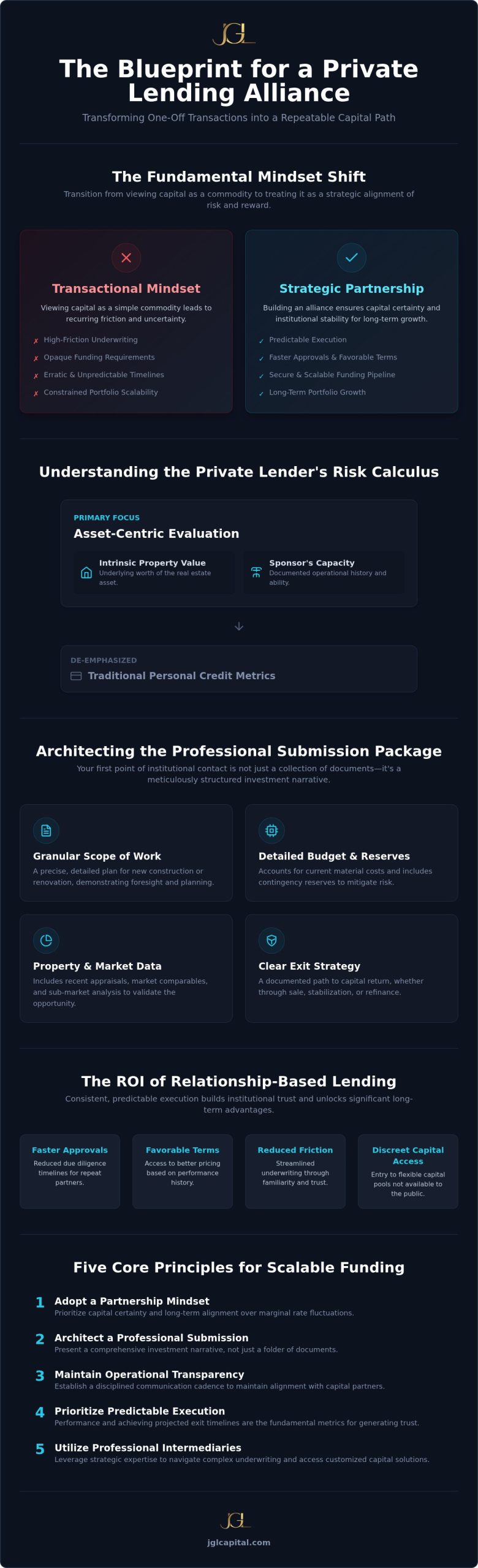
In the institutional capital markets, the most valuable asset you possess isn’t the equity in your portfolio, but the perceived predictability of your operational execution. Many sophisticated investors find themselves constrained by the opacity of underwriting requirements and the erratic nature of funding timelines that characterize purely transactional lending. You’ve likely experienced the frustration of high-friction underwriting or the lack of transparency that often accompanies traditional financing routes. Understanding how to build a relationship with a private lender requires a fundamental shift from viewing capital as a commodity to treating it as a strategic alignment of risk and reward.
This guide provides the analytical framework and professional protocols necessary to transform one-off transactions into a repeatable capital path. By mastering these standards, you’ll secure faster approvals and more favorable terms through a documented history of performance. We’ll examine the rigorous standards of documentation, the implications of the 2026 FinCEN Real Estate Report requirements, and the specific metrics that institutional partners use to evaluate long-term reliability. Our objective is to equip you with the disciplined approach required to establish a secure and scalable funding pipeline for your most complex real estate projects.
Key Takeaways
- Transition from a transactional borrowing mindset toward a strategic capital partnership to ensure long-term portfolio scalability and institutional stability.
- Master the essential protocols of how to build a relationship with a private lender by architecting a professional submission package that functions as a comprehensive investment narrative.
- Establish a disciplined communication cadence to provide operational transparency and maintain alignment with your capital partners throughout the asset management lifecycle.
- Prioritize predictable execution and the achievement of projected exit timelines as the fundamental metrics for generating trust and securing preferential financing terms.
- Utilize the strategic expertise of a professional intermediary to navigate complex underwriting standards and access highly customized, asset-backed capital solutions.
The Strategic Importance of Private Lending Alliances in 2026
In the institutional financial landscape of 2026, a private lending relationship is defined as a strategic alliance centered on mutual risk mitigation and capital efficiency. Developers who prioritize capital certainty over marginal interest rate fluctuations find themselves better positioned to capitalize on market volatility with agility. Understanding how to build a relationship with a private lender requires a fundamental shift from transactional borrowing toward a model of long-term capital partnership. This alignment is reinforced by pattern recognition, where consistent execution over multiple deals builds an institutional history that traditional lenders often fail to replicate. For a developer, capital certainty isn’t just a convenience; it’s the most valuable asset in a portfolio’s growth strategy.
Understanding the Private Lender’s Risk Calculus
Lenders in the private sector utilize a risk calculus that prioritizes the intrinsic value of the real estate asset over traditional personal credit metrics. Organizations such as JGL Capital LLC serve as expert intermediaries in this space, structuring complex transactions for institutional approval by focusing on the property’s underlying worth. A critical component of this evaluation is the “Sponsor’s capacity,” which measures the borrower’s operational history and their ability to preserve value under shifting conditions. This asset-centric philosophy is foundational to private money investing, ensuring that the capital source and the developer remain aligned on the project’s ultimate strategic objectives rather than being hindered by personal financial minutiae.
The Long-Term ROI of Relationship-Based Lending
The return on investment for a relationship-based lending model is realized through the systematic reduction of underwriting friction and due diligence timelines. For repeat partners, the lender’s familiarity with the borrower’s reporting standards allows for a more efficient allocation of resources and faster deployment of funds. Beyond speed, these alliances often provide access to discreet capital pools and flexible term structures that remain inaccessible to the general market. By maintaining a serious and disciplined approach to every engagement, developers secure a reliable, repeatable capital path that supports the creation of lasting legacies. This approach minimizes the high friction often found in initial underwriting and establishes a foundation for more favorable terms based on a documented performance history.
Architecting the Professional Submission Package
A loan submission package represents the first point of institutional contact between a developer and a capital source. It’s not merely a collection of disparate documents. Rather, it is a meticulously structured investment narrative that reflects the sponsor’s professionalism and analytical rigor. When investors evaluate how to build a relationship with a private lender, they must recognize that the quality of this initial presentation often dictates the velocity of the underwriting process. A high-register package preemptively addresses lender concerns, moving beyond basic data to provide a comprehensive view of the project’s viability and the sponsor’s execution capacity.
The Components of a High-Register Loan Package
Technical precision is non-negotiable for asset-backed evaluations. For those seeking new construction loans, the package must include a granular scope of work and a detailed budget that accounts for current material costs and contingency reserves. Property-level data, including recent appraisals and market comparables, should be presented alongside a clear exit strategy analysis. Whether the objective is a sale, stabilization, or a refinance into long-term debt, the lender needs to see a documented path to capital return. This level of detail aligns with a sophisticated guide to private lending, which stresses that transparency in property data reduces friction during the due diligence phase.
Developing a Compelling Investment Narrative
While data provides the foundation, the narrative provides the context. You must articulate the fundamental “Why” behind the transaction and the specific “How” of its execution. This involves highlighting the sponsor’s track record, emphasizing relevant industry experience, and demonstrating a history of successful asset management. Instead of obscuring potential project risks, the most effective narratives identify them early and present proactive mitigation strategies. This disciplined approach builds trust by showing that the borrower has considered all variables. For sponsors managing complex portfolios, partnering with experienced private money brokers can ensure that every submission package is structured to meet the exacting standards of institutional lenders.
The executive summary should serve as a concise distillation of the entire project. It must summarize the loan-to-cost ratios, the anticipated timeline, and the primary risk factors in a single, authoritative document. By providing this level of clarity, you signal to the lender that you value their time and understand their risk calculus. It’s a professional standard that separates serious developers from transactional borrowers.
Operational Transparency and the Communication Cadence
Operational transparency serves as the cornerstone of institutional trust. In the high-stakes environment of private credit, the distinction between a transactional borrower and a strategic partner lies in the consistency of their communication cadence. Establishing a disciplined reporting rhythm is essential for those seeking to master how to build a relationship with a private lender. This process moves beyond simple updates, requiring a methodical presentation of project milestones and financial health that aligns with the standards of institutional due diligence. Lenders don’t want surprises; they value the predictability that comes from proactive reporting.
The Disciplined Reporting Framework
Standardizing your monthly project updates and financial reporting creates a sense of stability for your capital partners. By utilizing technology portals for real-time document sharing, you ensure that all stakeholders have access to the same data set, reducing friction during the review process. This level of transparency is particularly vital when working with hard money lenders florida, where market dynamics often necessitate a higher register of accountability. A professional report should include:
- A summary of construction progress against the original timeline.
- Updated financial statements and budget-to-actual comparisons.
- Proactive identification of potential risks and their corresponding mitigation strategies.
Navigating the Construction Draw Process
The management of the construction draw schedule is perhaps the most critical trust-building exercise in a lending relationship. It’s an operational test of your project management capabilities. Aligning expectations on inspection timelines and fund disbursements ensures that capital flows efficiently, preventing project stagnation. You must provide clear evidence of work completed, accompanied by executed lien waivers and organized invoices. When a lender sees that you manage their capital with the same rigor you apply to your own equity, the relationship shifts from a service provision to a high-level strategic alliance.
Project delays or budget variances are inevitable in complex developments, but they don’t have to erode trust. Handling these challenges with professional integrity means communicating them early, before they become systemic issues. Presenting a variance alongside a logical, data-backed solution demonstrates that you’re a disciplined steward of the project’s value. It’s this commitment to transparency that secures your position as a preferred partner for future capital allocations.
Predictable Execution: Performance as the Primary Trust Metric
In the sphere of institutional credit, historical precision is the only metric that truly validates a sponsor’s capability. While the professional submission package initiates the alliance, it’s the final capital return that solidifies it. For those determining how to build a relationship with a private lender, the objective is the creation of “Predictable Outcomes.” This level of predictability allows an investment committee to view your portfolio not as a series of speculative risks, but as a reliable vehicle for capital preservation and growth. Trust is a byproduct of data, and nothing speaks more clearly than a documented history of meeting every financial obligation exactly as projected.
The Value of the Successful Exit
A formal Post-Close Debrief serves as a critical tool for institutional growth and portfolio scaling. This analysis examines the variance between the original pro-forma and the actual exit results, providing a transparent view of operational efficiency. Demonstrating an ability to pivot when market conditions shift is often more impressive to a lender than a project that faced no challenges at all. Returning capital on time, or even ahead of the projected schedule, carries significant psychological weight with capital providers. For developers utilizing fix and flip loans florida, this record of success becomes the primary lever for securing enhanced leverage and more competitive terms on subsequent acquisitions. It proves that the sponsor understands the local market dynamics and possesses the discipline to execute within the designated timeframe.
Scaling Through Repeatable Capital Paths
Once a sponsor demonstrates a history of meeting projected exit timelines, the capital relationship naturally matures from a series of transactions into a steady flow of liquidity. This evolution often involves transitioning from short-term bridge financing into stabilized commercial real estate loans. Sophisticated developers may also leverage their track record to establish Master Loan structures or dedicated credit lines, ensuring immediate liquidity for rapid-response opportunities. To align your next transaction with institutional-grade standards, consult with the specialists at JGL Capital LLC to explore customized capital solutions. Positioning your business as a preferred sponsor ensures that your projects remain at the top of the lender’s future allocation priority list.
Ultimately, the investment committee prioritizes sponsors who demonstrate a serious and disciplined approach to the generation of worth. When your actual results consistently mirror your initial projections, you transition from being a simple borrower to becoming a preferred partner for future allocations. This level of performance ensures that your access to capital remains stable even during broader market contractions. By treating every exit as a performance audit, you build a legacy of reliability that serves as the foundation for institutional-scale growth.
Scaling Your Portfolio through Broker-Facilitated Capital Access
While a direct lender is bound by the constraints of a specific balance sheet and a fixed risk appetite, a strategic broker manages a broad institutional ecosystem of capital. For developers seeking to understand how to build a relationship with a private lender, the broker serves as a high-level intermediary who streamlines the complexities of the capital markets. This approach is particularly advantageous for those managing national portfolios, as it provides a single point of contact for diverse financing needs across multiple asset classes. By leveraging a broker’s established history, you gain access to a level of market intelligence and capital certainty that is rarely available through direct-to-lender channels.
The Broker as a Strategic Ally
A professional broker acts as a strategic ally by matching specific project profiles with the capital sources most suited to their unique risk-adjusted return profiles. This allows developers to outsource the negotiation and structuring process to seasoned experts who understand the nuances of institutional underwriting. By utilizing a broker, you access a broader network of private capital that extends far beyond the appetite of any single institution, ensuring your project is positioned for optimal leverage and term flexibility. It’s a method that prioritizes the alignment of long-term objectives over simple transactional convenience.
The JGL Capital LLC Methodology
JGL Capital LLC’s approach is grounded in three decades of industry expertise and a commitment to disciplined stewardship. We prioritize the generation of worth through a methodical alignment of objectives between sophisticated borrowers and private capital sources. Our specialization in $10M+ complex transactions allows us to apply a high register of analytical rigor to every deal we structure, ensuring that property value remains the primary consideration. Contact JGL Capital LLC today to discuss your strategic financing requirements.
By moving beyond a transactional mindset and embracing a broker-facilitated partnership, you ensure that your access to capital remains as stable and predictable as your own operational standards. This strategic alignment is what allows for the creation of lasting legacies through careful, deliberate action in the commercial real estate sector. It ensures that your portfolio remains resilient, supported by a partner who values integrity and performance above all else.
Establishing a Legacy of Capital Certainty
Mastery of private capital markets requires a transition from viewing lending as a series of isolated events to recognizing it as a disciplined form of strategic alliance. By architecting high-register submission packages and maintaining a steady cadence of operational transparency, you align your project objectives with the risk models of institutional partners. Predictable execution remains the most potent metric for growth, as returning capital on time serves to validate your capacity as a steward of institutional worth. It’s this commitment to professional standards that distinguishes a sophisticated sponsor from a transactional borrower.
Understanding how to build a relationship with a private lender is the first step toward securing a scalable and repeatable capital path. JGL Capital provides the intellectual capital and institutional expertise required to navigate these complex markets. With over 30 years of experience and a national footprint specializing in $10M+ loan structures, we act as the professional intermediary that bridges the gap between sophisticated developers and discreet capital pools. Secure Your Next Strategic Capital Alliance with JGL Capital and begin the deliberate process of building a lasting investment legacy. Your portfolio’s future depends on the strength of your alliances.
Frequently Asked Questions
What is the most important factor in building a relationship with a private lender?
The most critical element in establishing institutional trust is the predictability of your operational execution. Lenders prioritize sponsors who consistently deliver outcomes that align with initial pro-forma projections, as this reduces the perceived risk of future capital allocations. Establishing a history of returning capital on time or early serves as the ultimate validation of your capacity as a disciplined steward of their resources.
Do private lenders care about my personal credit score?
Private lenders primarily prioritize the intrinsic value of the underlying asset over traditional personal credit metrics. While a credit score provides a baseline for financial responsibility, the underwriting process focuses more heavily on the “Sponsor’s capacity” and the project’s viability. This asset-backed approach allows sophisticated investors to secure financing based on the property’s potential rather than their personal income history or traditional credit standing.
How often should I communicate with my private lender during a project?
A disciplined communication rhythm involves standardizing monthly project updates and providing proactive reporting on key milestones. You should communicate early if budget variances or timeline shifts occur, rather than waiting for a lender to request an update. This transparency is essential for understanding how to build a relationship with a private lender that transitions from a simple transaction into a long-term strategic alliance.
Can I negotiate better interest rates with a private lender over time?
Negotiating more favorable interest rates or reduced origination fees is entirely feasible once a foundation of trust is established through successful project completions. As you build a history of predictable outcomes, the lender’s investment committee views your projects as lower-risk assets. Repeat partners often leverage this performance history to secure enhanced leverage and more flexible term structures that aren’t available to first-time borrowers.
What documents are essential for a professional private loan submission?
A high-register submission package must include a detailed executive summary, a granular scope of work, and a comprehensive project budget. You should also provide property-level data such as recent appraisals, market comparables, and environmental reports. A clearly documented exit strategy, whether through sale or refinance, is non-negotiable for institutional lenders who require a defined and realistic path to capital return.
How does a private money broker help in building lender relationships?
A professional private money broker acts as a strategic intermediary who manages an expansive network of institutional capital on your behalf. They facilitate the alignment of objectives between sophisticated borrowers and lenders, ensuring your project is matched with a capital source suited for that specific asset type. This single point of contact simplifies the negotiation process while providing access to discreet capital pools and market intelligence.
What happens if my project exit strategy changes mid-loan?
If an exit strategy must shift mid-loan, you must communicate the change immediately with professional integrity and analytical rigor. Presenting a revised, data-backed plan that accounts for current market conditions demonstrates your ability to pivot effectively. Lenders value sponsors who manage unforeseen project variables through proactive transparency rather than those who obscure operational challenges until they become systemic issues for the investment.
Why is asset-backed lending preferred by professional real estate investors?
Professional investors favor asset-backed lending because it offers greater speed and flexibility than traditional bank financing. This model focuses on the property’s intrinsic value and the project’s potential for worth generation, allowing for the financing of complex transactions that might not meet traditional credit standards. It provides the capital certainty required to scale large portfolios and execute on time-sensitive opportunities in volatile markets.